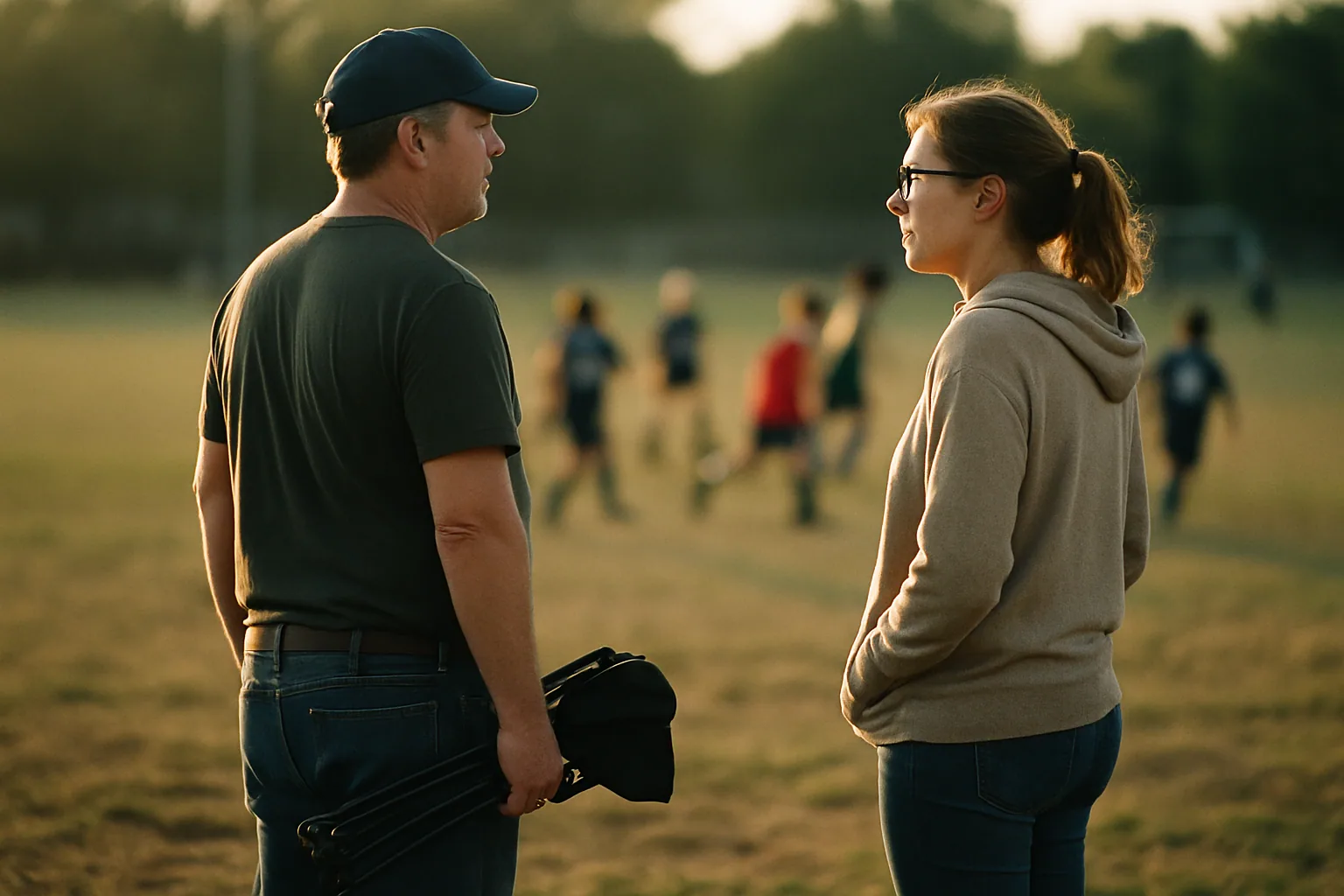
Most youth coaches rotate players through positions so every child learns the whole game, gets a fair turn, and stays interested in the sport. The tension for parents is real, though. Your child may love one spot, or dread another, and you are the one in the car afterward. This guide explains what rotation is for, what is reasonable at each age, how to talk about it, and what to ask a coach.
TL;DR
- Rotation is meant to build skills across positions, give equal opportunity, and keep kids in the sport. Youth league policy research lists all three.
- Younger kids benefit most from frequent rotation. As players get older, the focus shifts from trying everything to getting competent in a few spots.
- Equal playing time and rotation are separate questions. A coach can set a tournament lineup and still keep minutes roughly even.
- If your child wants to try a new position, say yes. If a move would crush their confidence, a good coach will not force it.
- Talk to the coach early and calmly, before the season gets emotional.
Table of Contents
- What rotating positions means, and why coaches do it
- What is reasonable at each age
- How coaches actually run rotations
- Rotation and playing time are not the same thing
- What to say when your child has feelings about a position
- Talking with the coach without making it awkward
- When coaches limit rotation, and how to read it
- Questions to ask your child’s coach
- Our perspective
- Gear and planning help for parent coaches
- FAQ
- Sources
What rotating positions means, and why coaches do it
Rotation simply means a child plays more than one position over a game, a week, or a season. Youth leagues usually have a few reasons for it.
A policy from an Australian junior football league says rotation gives players experience in different positions and the skills each one needs. It also gives everyone equal opportunity, and it helps keep kids in the game so they are less likely to quit for another sport. The details are from one league in one country, but the thinking shows up across youth sports.
There is a skills argument too. England’s football association notes that playing different positions lets young players develop different actions, such as turning, dribbling, or well-timed tackling, in different parts of the field. A defender who has played forward understands what a forward hates. A forward who has defended learns why a good pass matters.
That is the point of it. Rotation is not a reward or a punishment. It is how kids find out what they like, what they are good at, and how the whole team fits together.
What is reasonable at each age
There is no single national rule for rotation. Leagues, clubs, and school programs set their own, so your coach’s plan matters more than any chart. Still, the guidance we found follows a pattern: more rotation when kids are small, more specialization as they grow.
| Age band | What guidance suggests | Source |
|---|---|---|
| Around 6 and under | Skip positional coaching. Focus on technical ability. Rotate kids in and out and to different spots every few minutes so no one gets tired or bored. | U.S. youth soccer curriculum for U6 |
| Around 8 to 10 | Prioritize positional rotation. Tournament lineups can be set with that in mind, but playing time should stay about equal. | A U.S. youth league coaches handbook for 8U and 10U |
| Ages 8 to 12 | Every player should experience each of the five lines of field positions over three matches. | Australian junior football policy |
| Teens | Players naturally move into fewer positions. Goalkeepers are more likely to stay in goal. | Football Australia game time template |
| Roughly 13 to 16 | The emphasis shifts from rotating through everything to gaining competency in different positions. Players stay put until they have the basic strategies and skills. | Australian junior football policy |
Some of these are soccer and Australian football documents, and your sport will have its own details. The shape of the timeline is the useful part. If your 7-year-old plays one position all season, it is fair to ask why. If your 15-year-old stays in one spot, that may be perfectly healthy.
The U.S. soccer coaching guide makes the same underlying point: age is the key factor in choosing coaching content, so training should fit the developmental stage instead of treating every youth player the same. If you want a sport-specific look, our youth soccer positions explained for parents guide walks through what each role asks of a child.
How coaches actually run rotations
Parents often see rotation as a mystery that happens on the sideline. It is usually a simple system. Knowing the common ones helps you read what you see.
Rotating every few minutes (the youngest kids)
For the smallest players, the U6 curriculum suggests rotating kids in and out and to different positions every few minutes so no one gets too tired or bored. It can look chaotic. It is on purpose.
Set positions and partners (big rosters)
With a large roster, one youth league’s coaching guidance describes using “set positions and partners”, with players rotating in one-for-one at regular increments, such as every 10 minutes. The same document points out that rotating everyone at once can put a large group on the field that is not yet in the rhythm of the game. So if your child comes off while a friend goes on, that is likely the design, not a message.
Moving through positions week to week
Some recreational programs rotate by game instead of by minute. One U.S. rec soccer handbook suggests letting players play at least two positions in a game and move through positions weekly. You may see your child at the back one Saturday and up front the next.
Rotation inside practice
Practice is the best place to try new spots. The stakes are lower, nobody is keeping score, and a mistake is just a mistake. If your child is nervous about a new position, ask whether they can try it in a drill first.
Rotation and playing time are not the same thing
This is where many parent conversations go wrong. A child can rotate through five positions and still sit too long. A child can stay in one position and play the whole game.
The U.S. 8U and 10U handbook we reviewed says coaches should prioritize positional rotation, with tournament lineups set accordingly, while overall playing time stays approximately equal. In plain words: the lineup can bend, and minutes should still be fair.
Here is a quick way to sort what you are seeing:
- Is my child playing about as much as teammates? If yes, rotation is probably working as designed.
- Is my child always in the same spot? Ask why. There may be a good reason, or the coach may simply not have thought about it.
- Is my child always in the spot nobody wants? That is worth a calm question, not a complaint.
- Is the team rotating fairly but my child is unhappy? That is a conversation with your child first, and maybe the coach second.
For the bigger picture on minutes, our youth sports playing time guide goes deeper. One more idea from a recreational soccer coaching guide is worth keeping in mind: a healthy philosophy judges development by skills, not by winning.
What to say when your child has feelings about a position
The drive home is where position drama lands. You do not need a speech. You need a few honest, low-pressure sentences.
If your child is excited about a new position:
“You looked like you were having fun back there. What was the best part?”
If your child is nervous about being moved:
“New spots feel strange at first. What part feels hardest? We can tell Coach, or just try it at practice first.”
If your child wants to stay in one position:
“I get why you love it there. What do you like most about it? Let’s see if trying another spot can help you get even better at it.”
If your child feels they were put somewhere as a punishment:
“That sounds frustrating. Would it help if I asked Coach how positions get picked? I’d rather know than guess.”
Notice what these scripts avoid: they do not blame the coach, and they do not promise a position you cannot control. They keep the relationship with your child first. If you want more words for the car ride, our postgame script for parent coaches is built for exactly this moment, and our guide to youth soccer mental toughness covers what to do when confidence dips.
If your child wants to try something new
Say yes whenever it is safe and the coach agrees. The recreational soccer handbook we reviewed is blunt about it: if a child wants to try goalkeeper, let them try. Curiosity is worth protecting.
If a move would shatter their confidence
Rotation is not a test of toughness. England’s football guidance says that if a move would shatter a player’s confidence, the coach should not force it, and that a coach who is unsure can talk to the player’s parents. That is a useful reminder for both sides. You know your child’s temperament. A good coach will want to hear it.
Talking with the coach without making it awkward
The best time to talk about positions is early, before anyone is upset. The recreational soccer handbook recommends coaches make early, positive contact with parents, introduce themselves, and say they want to help each child have the best experience that season. A separate coaching guide prefers a face-to-face parent meeting early in the season to explain team goals and address concerns. If your coach has not done either, you can reasonably ask for a few minutes.
Keep a few habits in mind:
- Wait at least a day after a game before raising anything.
- Ask, don’t argue. “How do you decide who plays where?” lands better than “Why is my kid at defense?”
- Do not coach from the sideline. Our soccer parent sideline behavior guide covers what helps and what hurts.
- Learn what the coach expects from you. Our guide on what coaches actually want from parents at practice is a good starting point.
If you are the coach, fairness starts with how you evaluate. A clear, written approach helps you explain choices later, and tryout evaluation forms show one way to score players consistently so the conversation with parents is about skills, not hunches.
When coaches limit rotation, and how to read it
Rotation does not last forever, and that is normal. As kids get older, teams start to need specialists. The Football Australia template says that in the U12 to U18 range players naturally move into fewer positions, and goalkeepers are more likely to stay in that role.
The Australian junior football policy puts it this way for ages 13 to 16.5: the goal shifts from rotating through everything to gaining competency in different positions, and players should stay in a position until they pick up its basic strategies and skills.
If the coach limits your child’s rotation, a good explanation sounds like this: “Here is what I see, here is what I want to build, here is what you can work on.” A vague one sounds like “That is just how it is.” You are allowed to ask for the first kind.
If you are weighing a switch to a more competitive team, positions will matter more there. Our guides on rec soccer vs travel soccer for 8 to 10 year olds, youth soccer levels, and what to expect at tryouts can help you see where specialization starts.
Questions to ask your child’s coach
Keep this list on your phone. You do not need all of them, and you should not fire them off at once.
- How do you decide who plays where this season?
- Will every player try more than one position?
- How does rotation work in games versus tournaments?
- How do you keep playing time about even?
- What skills should my child work on to be ready for a new position?
- If my child is uncomfortable in a spot, what is the best way to tell you?
- Does the plan change as the season goes on?
Then listen. The answer will tell you whether the coach has a plan or is deciding week to week. Either can be fine. You just want to know which.
Our perspective
Parents ask us about positions as though they were asking about a lineup. Most of the time they are really asking about their child’s confidence.
We think of it as three drives. On the drive there, you set the tone: “Try something new today, and be brave.” During the game, you step back and let the coach and your child do their work. On the drive home, you listen first. If your child was moved, ask how it felt before you say a word about whether it was right.
What we have seen from parents who have done this for years is that the position matters less than the relationship. A child who feels safe trying things grows. A child who feels judged in the car stops trying.
That is why we build scripts, age pathways, and practical guides around real situations like this one. Use rotation to help your child learn, and keep the car ride warm.
Jeff
Gear and planning help for parent coaches
If you are the one running the rotation, a few simple tools make it easier: a clipboard or lineup card, something to track minutes, and a way to record a few clips so you can show a child what they did well in a new spot. We list what is worth buying, and what is not, in our parent-coach gear guide and across our what to buy pages.
If you want more of this, the rest of Parent Coach Desk is at parentcoachdesk.com, organized by the drive there, the game, and the drive home. Our soccer pathway is a good place to start.
FAQ
Should my young child play one position all season?
For the youngest players, guidance we reviewed suggests avoiding positional coaching altogether and focusing on technical ability. Rotating them every few minutes is common. If your child is under about 8 and stays in one spot, a polite question to the coach is reasonable.
What if my child hates the new position?
Start by asking what feels hard, not by telling them it will be fine. Then talk with the coach about trying it in practice first. England’s football guidance says a coach should not force a move that would shatter a player’s confidence.
Does rotation mean equal playing time?
Not automatically. One U.S. youth league handbook asks coaches to prioritize rotation at 8U and 10U while keeping overall playing time about equal, so the two are related but separate. Ask your coach how both are handled.
When do kids stop rotating?
There is no fixed age. Guidance from Australian football bodies shows players moving into fewer positions through the teen years, with goalkeepers most likely to stay put. Your league and sport may differ, so check the team’s policy.
Should I ask the coach to move my child to a better position?
It is better to ask how positions are chosen and what your child can work on. Requests for a specific spot tend to put the coach on the defensive. Questions about development usually get a more useful answer.
Sources
- SANFL Juniors Player Rotation Policy (Australia)
- Why your players should try different positions (England Football)
- U6 Coaching and Player Development Curriculum
- Large roster lineup guidance
- Recreational soccer handbook (Chippewa Falls)
- JGFA Coaches Handbook 8U and 10U
- A Guide to Coaching Recreational Soccer
- Football Australia Game Time Policy Template
- U.S. Soccer Guide to Coaching