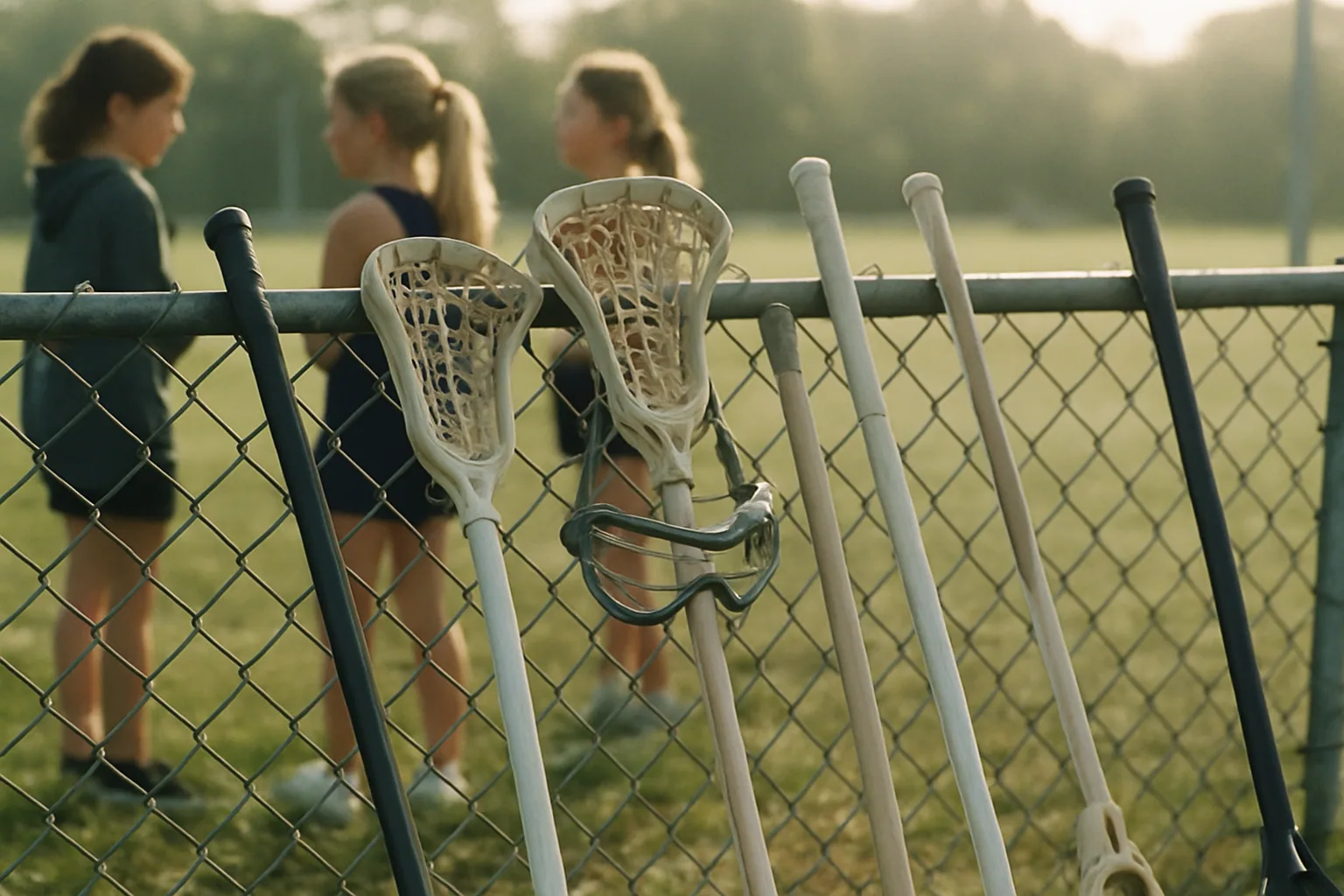
She’d been sitting in a camp chair for ten minutes watching her older brother’s practice before she said it. “Why does he get a helmet and I don’t?” Then, before we could answer, “and why can he hit people with his stick and I’m not allowed to touch anyone?” She wasn’t upset exactly. She was doing the thing nine-year-olds do where they notice a discrepancy and want the accounting to make sense immediately, out loud, in front of whoever’s closest.
We’d watched both of their practices for two seasons by that point and somehow never had to explain the difference in one sitting before. Her brother’s lacrosse has full pads, a helmet, and legal body checking. Hers has a mouthguard, goggles, and a rule that a defender can barely touch her stick, let alone her body. Same sport name, same season, same field some Saturdays, and from a nine-year-old’s seat in a camp chair, wildly different rules that looked like somebody had decided her version mattered less.
The honest answer is that they are two different sports that happen to share a name and a stick. Boys lacrosse grew out of a version of the game built around contact, protective equipment, and body checking as a legal part of play. Girls lacrosse grew out of a different lineage, one that was never built around checking, which is why the safety equipment looks completely different. A field player in girls lacrosse wears goggles instead of a helmet because the game was never designed to include the kind of contact a helmet protects against. It isn’t a boys’ game with the hitting removed. It’s its own game, built on its own rules from the start.
We said something close to that in the car, and she pushed back the way a nine-year-old does. “But he gets to hit and I don’t, that seems like his is more fun.” That’s a fair thing for a kid to feel, and we didn’t try to argue her out of the feeling. We said that some kids do think the checking looks like more fun to watch, and that’s a real opinion, not a wrong one. We also said that a lot of girls lacrosse players like that their game rewards speed and stick skill without the checking, because it’s a different kind of hard, not an easier kind.
We avoided saying her sport was “just as good” in a way that sounded like we were selling her something. Kids can tell when an answer is doing damage control. Instead we tried to describe what each sport actually asks of the player. Her brother’s sport asks him to absorb contact and use his body to create space. Her sport asks her to move faster than her defender and protect the ball with footwork and stick angle because she can’t shove her way out of trouble. Both are hard. They’re just hard in different directions.
The equipment question got easier once we treated it as a safety design question instead of a fairness scorecard. She asked why nobody just gave her a helmet too, if hers is real contact-free lacrosse and safety matters. We told her that’s actually been debated in the sport for years, whether headgear should be more standard even without checking, and some leagues do require or allow more protective headgear now. That’s a real and reasonable question, not a naive one, and we didn’t pretend the current setup was beyond debate. We just made clear it wasn’t a case of anyone deciding her safety mattered less. It’s a sport built around not needing the same equipment because it isn’t played the same way.
A few weeks later, she asked a completely different question that told us the first conversation had actually stuck: whether the rules would ever change to look more like her brother’s. We said probably not, that the two versions of the sport had been separate for a very long time and both had their own governing rules that got updated on their own track, not toward each other. She thought about that and said “good, I don’t want mine to be like his, I just wanted to know why it wasn’t.” That distinction mattered. She hadn’t been asking us to fix anything. She’d been asking us to explain something that looked, from the outside, like an unexplained inequality.
We also noticed, watching more of her games after that conversation, that we started narrating the game differently to ourselves. Instead of quietly comparing her sport to her brother’s in our own heads, the way we’d probably been doing without realizing it, we started watching her footwork and her stick angle as their own skill set worth admiring, not a workaround for a sport that couldn’t include checking. That shift in how we watched turned out to matter more than the conversation itself.
The gear guide for girls lacrosse is worth reading too, since it explains exactly why her equipment list looks so different from his.