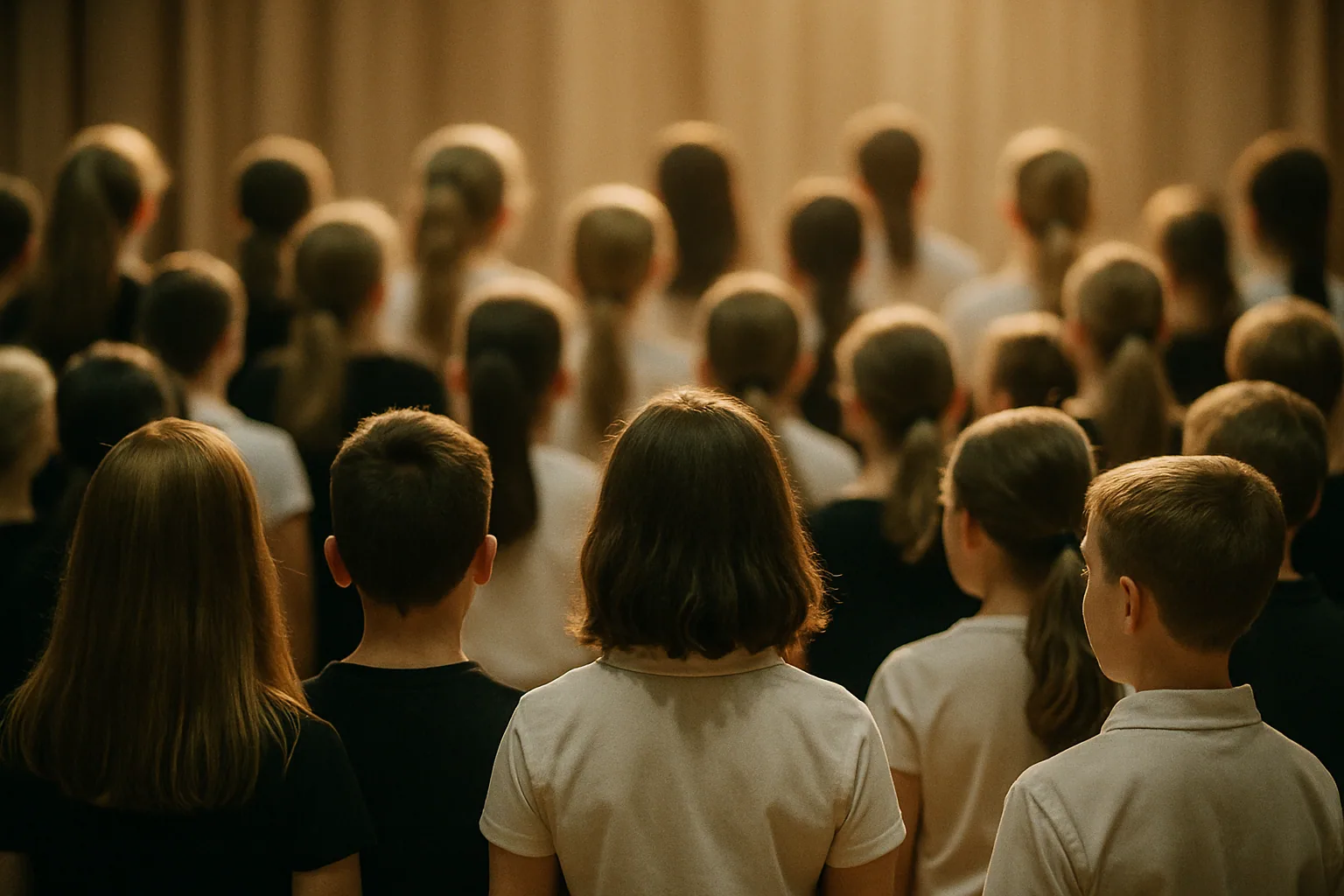
She came home with a folder. Inside was a piece in Latin, three pages long, that she’s supposed to memorize for the December concert. You looked at the words and recognized maybe one of them, Kyrie, eleison, and the two of you stared at the page together at the kitchen table. Then you remembered: this is what choir does. Here’s what she’s actually supposed to be doing with the lyrics, and how to help from your side of the table.
Why choirs sing in other languages
The classical choir repertoire was written across hundreds of years across many countries. Mozart wrote in Latin and German. Brahms wrote in German. Fauré wrote in French. The sacred Latin repertoire goes back over a thousand years. A school choir that only sang in English would have access to maybe ten percent of the great repertoire, and most directors don’t want to limit kids to that. So they learn to sing in Latin, German, Italian, French, Spanish, sometimes Hebrew, sometimes Russian, sometimes more. This is normal and good.
What she actually needs to do
Three things. Pronounce the words correctly, every language has rules, Latin pronounces differently from Italian, German has umlauts that change the sound, French has nasal vowels and silent letters, and the choir teacher will teach the pronunciation and she just needs to follow. Know roughly what the piece is about, not a word-by-word translation, but she should know whether she’s singing a praise hymn, a love song, a lament, or a celebration, because the meaning shapes how she sings. And mark the music, most kids write phonetic spellings above difficult words in pencil, which is standard and the choir teacher expects it.
Latin first
Most school choirs sing Latin most often, because the sacred classical repertoire is largely in Latin, and the good news is that Latin has only about five vowel sounds and they’re pure and consistent. Latin “a” is always “ah,” Latin “e” is always “eh,” Latin “i” is always “ee,” Latin “o” is always “oh,” Latin “u” is always “oo.” Consonants are similar to Italian, “ce” and “ci” are soft like “che” and “chi,” “ge” and “gi” are soft, “gn” is “ny” as in “canyon.” A kid who learns Latin pronunciation can sight-read most Italian as well, because the two languages share most of their sounds.
German
German has a few specific sounds that English speakers struggle with. Umlauted vowels: “ä” is a flat “eh,” “ö” is between “uh” and “oh,” “ü” is between “ee” and “oo.” “Ch” has two pronunciations, after bright vowels it’s a soft hiss like the “h” in “hue,” after dark vowels it’s the back-of-throat sound like Scottish “loch.” “R” is rolled or trilled in classical singing, not always in spoken German but always in choir. “W” is “v,” “v” is “f,” “s” before a vowel is “z.” The kid will struggle with these for a few weeks and then she’ll have it.
French
French is the trickiest for English speakers. Nasal vowels, words like “bon” or “vin” or “en” don’t pronounce the n, the vowel goes through the nose. Silent letters, final consonants are often silent, “et” is “ay,” “vous” is “voo.” Liaison, sometimes a silent consonant gets pronounced when the next word starts with a vowel, so “vous avez” links to “vooz avay.” A kid singing French for the first time will sound stiff, after a few months she’ll sound natural, after a year she’ll sing French as comfortably as English.
What you can do at home
A few small things. Listen to the piece together, most choir pieces are on streaming services, so find a professional recording and play it during dinner one night so she hears the pronunciation modeled. Look up the translation, just a two-sentence summary like “this is a prayer asking for mercy” or “this is a folk song about a young person leaving home,” because the context helps her put meaning behind the words. Don’t correct her pronunciation if you don’t speak the language, trust the choir teacher, because your American English version of a German word is probably wrong in a different way than her version is wrong. And mark the music for her only if she asks, because most kids want to mark their own and the marks are a study tool, not an answer.
When the kid is overwhelmed
Some kids panic at foreign language pieces. They feel like they’ll mess up the words. They feel exposed. A few moves: tell her everyone is in the same boat, because the kid two seats down is also struggling with “Veni Creator Spiritus.” Remind her that the piece is sung as a group, she’s not a soloist, the director is conducting forty voices, not forty individuals. Practice five minutes a day on just the lyrics, spoken not sung, and once she can speak the words at performance tempo without stumbling, the singing falls in.
The bigger thing
A kid who learns to sing in five languages by the end of high school has done something most adults never do. She’s engaged with the literature of multiple cultures, learned that meaning is not the same as words, learned that beauty doesn’t need a translator. A few of these kids will keep singing as adults, most won’t, but all of them will remember the pieces. Foreign language repertoire is sticky in a way that English pop songs aren’t, the Latin Kyrie from seventh grade is still in their head when they’re forty.
That’s the gift. That’s what choir is teaching her, even when she doesn’t realize it. The pathway by age shows how repertoire gets harder year over year, foreign languages included.