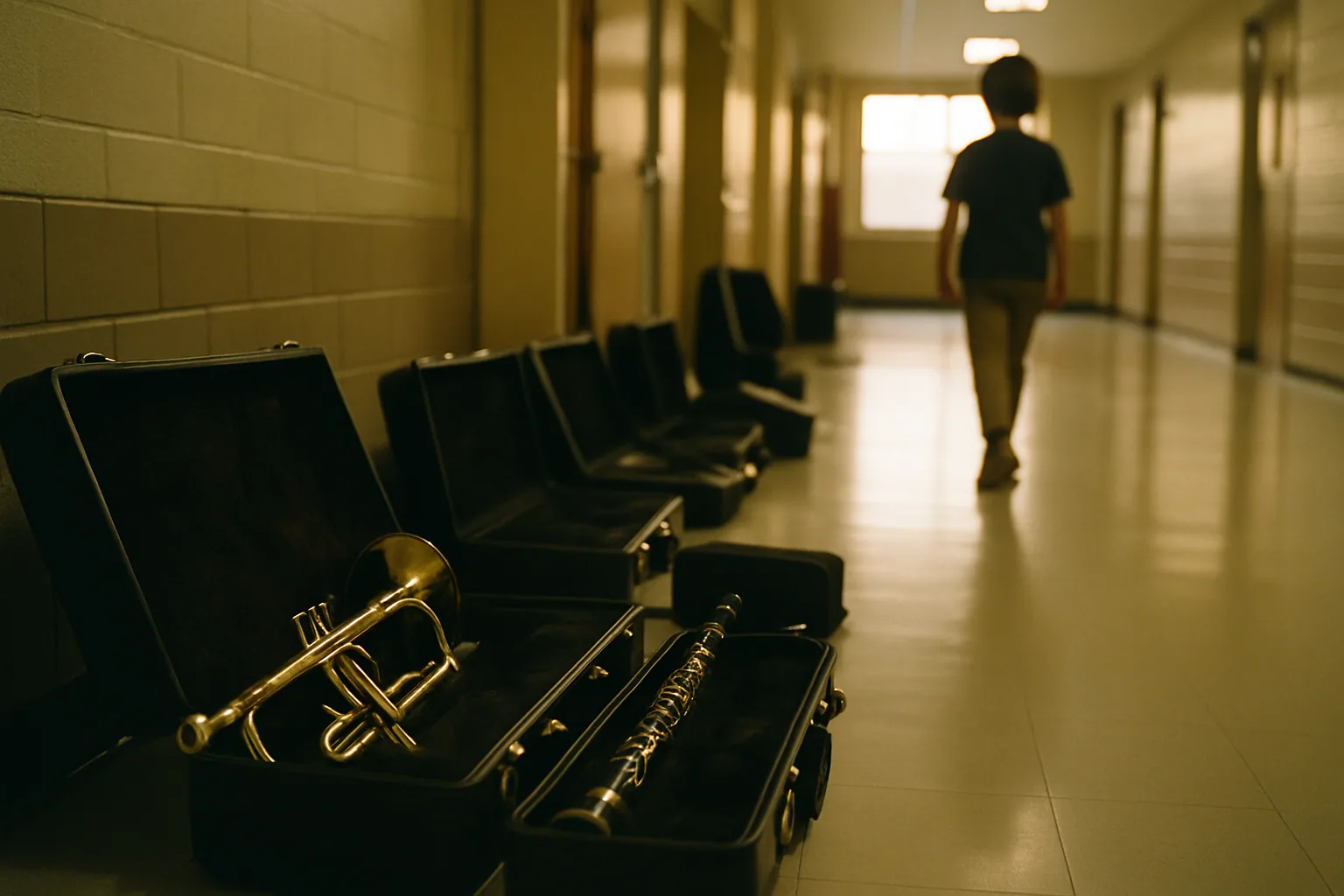
Tuesday afternoon. You’re pulling out of the driveway to drive him to lessons, and he’s looking out the passenger window at the same trees he’s looked at every Tuesday for five years. He says it without turning his head, he wants to quit. Not band. Just lessons. He’s had the same teacher since third grade and now at thirteen he’s done. You almost turn the car around. Then you keep driving. Here’s how to think about this without making the wrong call.
What’s probably going on
Three things are usually happening at once at this age. The first is that he’s outgrown the teacher, a first instrument teacher who was perfect at nine may not be the right teacher at thirteen, and he’s gotten past the basics and needs something the current teacher can’t give him. The second is that the schedule is squeezed: middle school homework and other activities are taking real time, and lessons are an obvious thing to cut. The third is that he’s thirteen, and cutting things adults set up for him is a developmental milestone. He’s asserting that this is his life now.
All three are real. None of them give you the same answer.
The question to ask first
Does he still want to play. If yes, the lesson question is separate, he’s not quitting music. If no, the lesson question is moot, he’s quitting music and the lesson is just the proxy. Most middle schoolers in this conversation still want to play band; they just don’t want this teacher anymore.
A new teacher is often the answer
If he’s outgrown the teacher, the answer is usually to find a new teacher rather than to drop lessons entirely. Signs of a teacher fit problem: he doesn’t learn anything new at lessons anymore, he’s bored, the teacher keeps assigning the same kind of material, and he’s stopped practicing because lessons feel uninspiring.
A new teacher can be a college student studying music ed at a nearby university, a retired band director, a current professional player, what’s right depends on what he wants to do. If he’s heading toward all-state auditions or thinking about playing in college, a serious teacher is worth real money, probably forty to sixty dollars per half hour with someone who has a college music degree. If he’s playing for fun and wants to stay in band, a less expensive teacher who keeps him moving is fine, a community music school often has these.
When dropping lessons is the right call
A few cases. He’s been in lessons for five-plus years and has hit a plateau where another year of one-on-one work won’t make a meaningful difference, some kids reach a point where what they need is more ensemble experience, not more solo coaching. The financial pressure is real, lessons cost real money, and if the budget is tight and the kid isn’t aiming at music long-term, the band program at school plus self-directed practice can be enough. The kid is over-scheduled, a thirteen-year-old who’s in band, on a club sport, in a school play, and has three honors classes is at capacity, and cutting one thing is the right move, with lessons often the one to cut.
The deal to consider
If he wants to drop lessons but stay in band, here’s a deal that often works. Drop the weekly lessons. Sign up for one private lesson per month or every other month with a check-in teacher. This isn’t for skill building, it’s for accountability. The teacher hears him play, gives him three things to work on for the next month, and lets him go. It costs about a quarter of what weekly lessons cost, keeps a professional eye on the playing, and avoids the slow drift that happens when a band kid has no outside instruction. Most teachers will agree to this if asked.
What you give up by quitting entirely
If he drops lessons entirely and only plays in band, here’s what happens: his technique stops getting refined because band directors don’t have time in rehearsal to fix one kid’s embouchure or bow grip, and bad habits accumulate. His tone quality plateaus, and the single biggest predictor of high school band success is tone, which is built in lessons. His reading speed lags because lesson teachers assign sight-reading and most band directors don’t.
This is fine for a kid playing band for the social experience. It’s a slow ceiling for a kid who wants to play at all-state level or major in music.
The long view
Most adult musicians have a story about the time they quit lessons in middle school, and many of them also have a story about the teacher who got them back into it in high school. The pattern is common. If your kid wants to quit, you can let him. If he comes back to it on his own, he comes back hungrier. If he doesn’t, the years he had were still real.
A short break from lessons is not a tragedy. A new teacher might be the better answer. A monthly check-in is a good middle ground. The kid still in band is still a band kid, keep that part going, and let the lessons take whatever shape they need to take. The pathway by age has more on how private lessons tend to fit into each stage, if you’re weighing this decision.