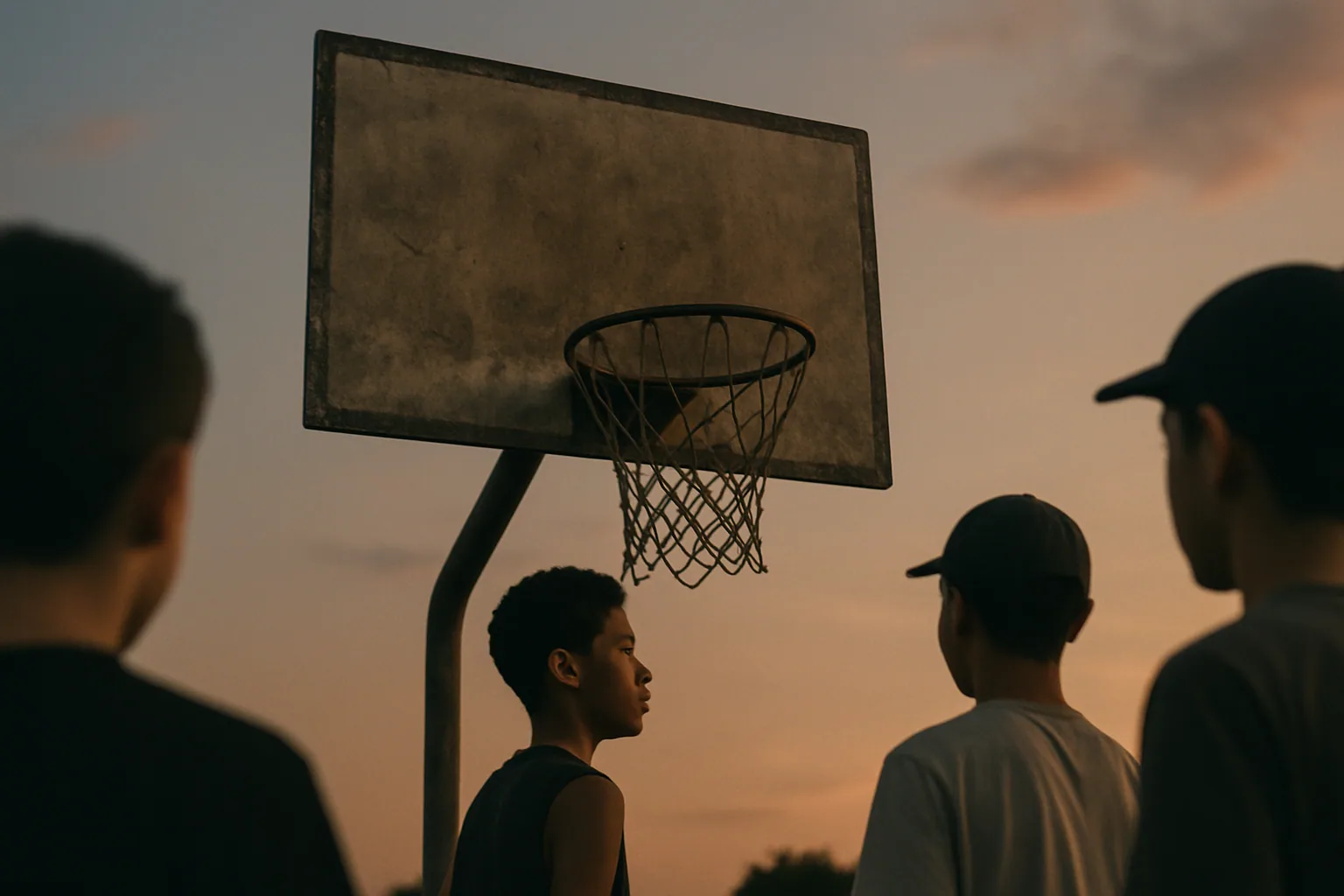
Six o’clock on a Tuesday, one hoop, eleven fifth graders, and you have an hour. The worst thing you can do with that hour is a single-file layup line. Ten kids stand still while one shoots.
Here is a plan that keeps every player moving for 55 minutes. It fits USA Basketball’s youth guidelines, which set practice at 45 to 75 minutes, twice a week, for ages 9 to 11.
And no drill runs past 11 minutes. NFHS practice-planning guidance puts a kid’s focus at roughly one minute per year of age, so an 11-year-old gets about 11 minutes before the drill goes stale.
The 55-minute timeline
Minutes 0 to 10 are warm-up and ball handling, and minutes 10 to 30 go to one focus skill split into short drills. Then come stations and small-sided games from 30 to 42, followed by eight minutes of controlled scrimmage. Water and a 60-second recap close it out at 55.
Write it on a whiteboard or tape it to the bleachers. NFHS tells coaches to post the plan and stick to it, and a posted plan lets your volunteers run their piece without asking you every five minutes.
Two adults can run all of it. One teaches the skill block and keeps the clock, while the other runs station rotations, resets cones between groups, and calls subs during the scrimmage.
Warm-up: every kid on a ball
Five minutes of moving warm-up first: high knees, lateral shuffles, backpedals, arm circles. Then five minutes of ball handling where nobody waits.
Partner mirror dribbling works well here. One player leads changes of direction and the other copies, both dribbling. Finish with a knockout game inside the three-point line, where each kid protects their own ball and tries to tap away a neighbor’s.
Coach three things only: eyes up, fingertips, ball low. Nothing else this early in the night, because a long list of cues in a warm-up just slows the dribbling down.
The skill block: one skill, three steps
Pick one skill per night: dribbling, passing, or shooting. A 10-year-old who hears six cues in one evening remembers none of them by the next practice. One.
Run it in three steps. Show the skill with one or two cues. Give everyone a lot of reps with light correction, then add pressure once most of the group is getting it right: a defender, a time limit, or a decision.
For dribbling, play tag inside a grid with one defender. For passing, run partner passes while jogging the length of the floor, scored on accuracy, not speed. For shooting, put small groups at three spots near the rim and fix form before anyone steps back.
Adjust the drill, not the kid. A player who is struggling shoots from a step closer, and a strong one gets a defender. Same drill, different challenge.
Stations and small games
Stations turn a drill into a decision. Run four, about three minutes each, and rotate on your whistle.
Station one is a cone weave while the player reads a coach’s hand signal, and station two is two-on-one keep-away. Station three is shooting with a partner rebounding and feeding.
Station four is 3v3 half court. A basket counts there only after a completed pass, which pushes kids to look up before they drive.
Pair players at every station so one steps in the second the other finishes. NFHS warns that single-line drills waste reps and bore the whole team. Pairing fixes both in one move.
Scrimmage that still teaches
The scrimmage is the reward, but it should still teach. Limit each possession to two or three dribbles, or count a basket only after an extra pass, so the rules reinforce the night’s skill.
Before you start, run a few minutes of 2-on-1 and 3-on-2 in transition. Coach talking and getting back on defense over gambling for steals.
Keep it to 8 to 10 minutes. Stop play briefly to fix spacing instead of letting the same mistake repeat, and rotate subs every two to three minutes so minutes stay close to even.
Track it in two lines
After practice, jot two or three notes: who is close on tonight’s skill and who needs more reps. Move a kid up when you see consistent success, not effort alone.
Watch the weekly total too. USA Basketball sets a maximum of 5 hours of organized basketball per week for ages 9 to 11, and that count includes games.
Two practices plus a weekend game fits under it. A third team stacked on top of all that, with its own practices and its own Saturday games, does not.
The concussion rule
Basketball is a contact sport more than parents expect. A CDC HEADS UP fact sheet reports that 2 out of 3 concussions in boys’ basketball come from a collision with another athlete.
If you suspect one, the player sits for the rest of the day. No exceptions, no “shake it off.” Return follows a gradual, step-by-step plan under a healthcare provider’s guidance, and our concussion protocol guide walks through it with scripts for talking to parents.
Gear and helpers
You need very little. A ball for every kid, a bag of cones, and two colors of pinnies cover the whole plan. Our what to buy guide and basketball hub list the basics and what they cost.
Some parent groups use a team camera system to capture scrimmage clips, and a team communication plan keeps practice times and changes in one place. Both are optional. A posted plan and a whistle matter more.
For more drills to swap into this timeline, see our youth basketball drills guide. For the longer arc of a season at this age, read coaching 10 to 12 year olds.
If you coach your own kid, coach the team. Give your child the same reps, the same corrections, and the same water break as everyone else.
FAQ
How long should a U12 basketball practice be?
USA Basketball recommends 45 to 75 minutes for ages 9 to 11, and 60 to 90 minutes for 12 to 14. Two practices a week is the guideline for 9 to 11.
How many drills fit in one practice?
Three or four, built around one skill. Keep each one under about 11 minutes, since NFHS puts attention at roughly one minute per year of age.
How much of practice should be scrimmage?
About 8 to 10 minutes of an hour. The rest goes to skill work and small-sided games, where every player touches the ball far more often than in a 5v5 game.
What if a player might have a concussion?
Remove them right away and keep them out for the rest of the day. They come back only through a gradual plan a healthcare provider guides.
How do I keep practice from feeling chaotic?
Post the plan, give each adult one job, and pair players at every single drill so nobody stands around waiting. Lines are where chaos starts.
Sources
- Youth Basketball Guidelines - USA Basketball
- Effective Practice Planning - NFHS
- Heads Up: 2 out of 3 Concussions in Boys’ Basketball Result from a Collision with Another Athlete - CDC