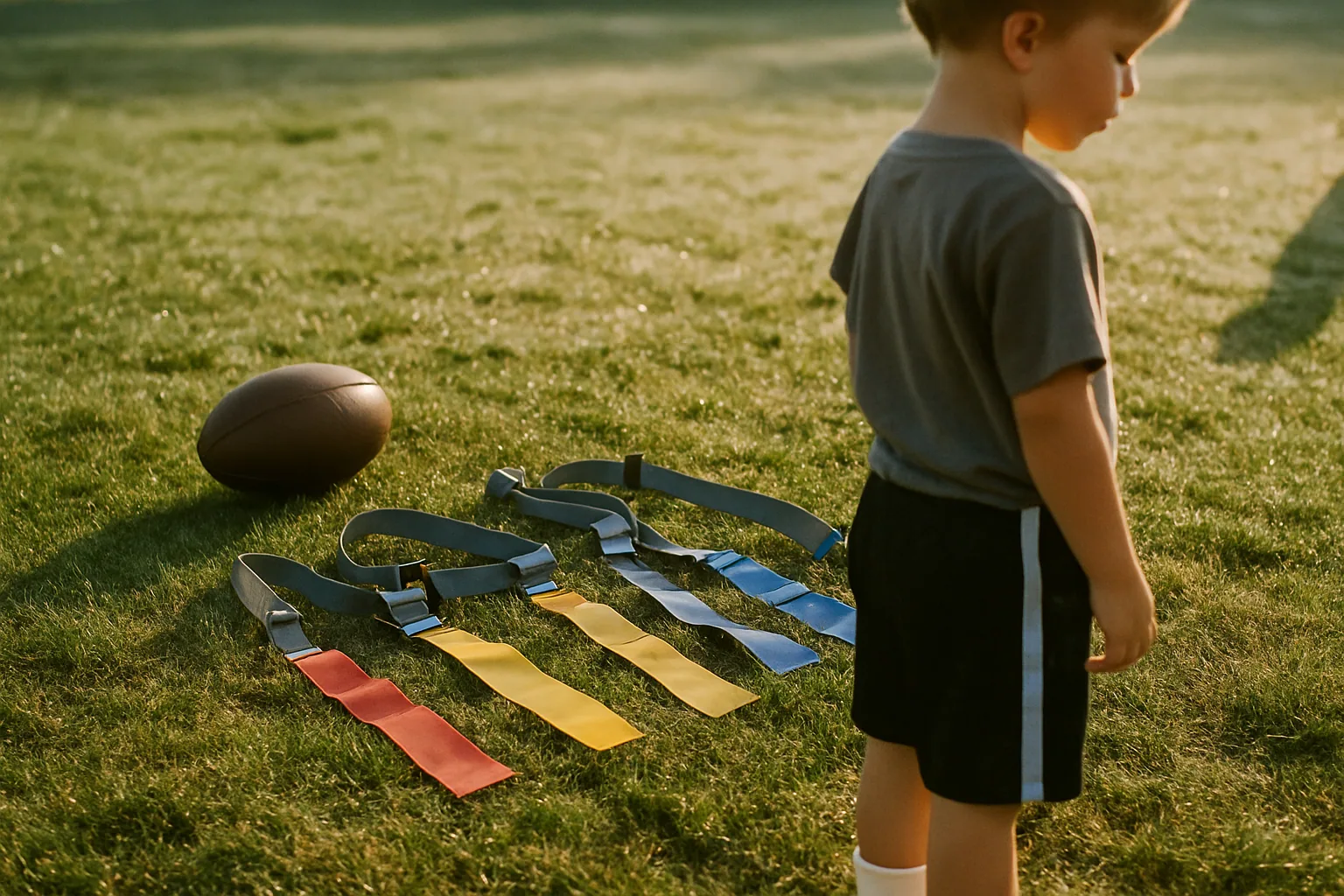
Run these first: a two-line passing warm-up, a gauntlet flag-pull drill, a route tree relay, cone shuttle cuts, a catch-and-score small game, mirror coverage, and circle handoffs. Together they cover throwing, catching, flag technique, and footwork in one session. Pick the 30, 45, or 60-minute template below based on your practice window, then scale reps to your players’ ages.
This post contains affiliate links. We make a small amount when you buy through them. We only recommend products we use ourselves.
TL;DR:
- Focus on a small set of core drills that develop throwing, catching, flag pulling, footwork, and decision-making, rather than numerous repetitive exercises.
- Prioritize teaching flag pull techniques through gradual progressions, as proper hand placement and angles directly impact success in game situations.
- Incorporate small-sided games like catch-and-score to teach reading coverage and decision-making under realistic pressure.
- Ensure warm-ups include mobility, activation, and speed drills to prevent injuries related to sprinting and cutting, especially for young players.
- Follow a structured practice plan that combines warm-up, skill stations, small-sided games, and cooldown, adjusting repetitions based on age to maintain engagement.
Table of Contents
- Top Flag Football Drills at a Glance
- Offense Drills: Passing, Catching, Routes, and Ball Handling
- Defense Drills: Flag-Pulling, Pursuit, and Coverage
- Warm-Up and Conditioning Drills for Young Players
- Sample Practice Session Plans by Time and Age
- Coaching Progressions: What to Teach First
- Safety Checklist Before Every Practice
- Printable Practice Pack From Parent Coach Desk
- What Youth Flag Coaches Get Wrong About Drills
- Sources
Top Flag Football Drills at a Glance
You don’t need forty drills. You need eight or nine that hit every core skill, plus a couple of small games that keep kids from tuning out. Here’s the toolkit.
- Two-line passing warm-up: Two lines face off 10–15 feet apart, throwing and catching on the move. Setup: cones marking lines, one ball per pair. 5 minutes, 15–20 reps per player. Age tweak: 5–7 year-olds start at 8 feet with underhand tosses; 11–13 year-olds add a step-and-throw.
- Gauntlet flag-pull: A ball carrier runs a 15-yard lane while defenders pull flags one at a time. Setup: two cone lines forming the lane. 8 minutes, 6–8 reps per group. Age tweak: younger players walk the lane first; older players sprint full speed.
- Route tree relay: Receivers run a slant, a post, and a flag route against air, then against a defender. Setup: five cones per route tree. 10 minutes. Age tweak: 8–10 year-olds run two routes max; 11–13 year-olds run the full tree.
- Cone shuttle cuts: Players sprint to a cone, plant, and cut at a sharp angle to a second cone. Setup: three cones in an L shape. 5 minutes, 4 reps per player.
- Catch-and-score small game: Three-on-three, no rushing, first team to five catches in the end zone wins. This replaces isolated catching reps with game pressure.
- Mirror coverage: One defender shadows a receiver’s lateral movement without touching, working footwork instead of speed.
- Circle handoff practice: Players form a circle and hand off on the move, calling out “ball” each exchange.
- One-on-one contain drill: A defender tries to stay square to a ball carrier in a 10-yard box, forcing a decision rather than a chase.
Pro Tip: Track successful flag pulls per rep instead of just wins and losses in scrimmages. A kid pulling 3 out of 5 flags cleanly is progressing even if their team loses the game.
Offense Drills: Passing, Catching, Routes, and Ball Handling
Offense in flag football comes down to timing and hands. Build both with a repeatable progression.
- Passing warm-up by distance. Start at 8 feet for ages 5–7, move to 12–15 feet for 8–10, and stretch to 20+ feet with a shoulder turn for 11–13.
- Route-running with footwork cues. Teach the “stem” (running straight at the defender) before the break. Call out “plant, cut, look” as a verbal cue during reps.
- Catching progressions. Start with chest-high tosses, then work high balls, low balls, and finally catches with a defender’s hand in the passing lane. Coach hands forming a “diamond” or “basket” depending on ball height.
- Handoff and ball security. Have runners cradle the ball high and tight, switching hands away from a chasing defender during circle handoffs.
Defense Drills: Flag-Pulling, Pursuit, and Coverage
Missed flags usually come down to bad hand placement and poor angles, not lack of effort. Fix both with a staged progression.
- Stationary flag-pull. Defender starts at arm’s length from a standing ball carrier and practices a downward grab motion, not a slap.
- Controlled chase. Ball carrier jogs a straight line while the defender closes the gap and pulls at three-quarter speed.
- Full-speed angle pursuit. Ball carrier runs at game speed; defender takes the correct pursuit angle instead of chasing straight from behind.
- Gauntlet and box drills. Multiple defenders line a lane or box, forcing the runner to read angles and defenders to react fast, which sharpens hand placement under pressure.
- Mirror and shadow drills. One defender mirrors a receiver’s cuts without contact, building the lateral movement and containment skills flag defense depends on.
The NFL FLAG drill and video library breaks this progression down visually, including flag-pulling technique demonstrated by an NFL club’s youth series. Useful as a model for coaches who want to show, not just tell.
Warm-Up and Conditioning Drills for Young Players
A good warm-up sequences mobility, activation, and progressive speed, and it matters more than most parent-coaches assume.
- Dynamic mobility. Leg swings, walking lunges, and ankle circles for 3 minutes.
- Activation. High knees, butt kicks, and lateral shuffles for 2 minutes.
- Progressive speed runs. Three build-up sprints at 50%, 75%, and 90% effort.
- Acceleration and deceleration work. Short 10 to 15-yard sprints that end with a controlled stop, not a coast.
- Cutting mechanics. Add a 45-degree cut at the end of a sprint to rehearse the same movement receivers and defenders use in games.
Warm-ups built this way, moving from mobility to activation to progressive speed, help prevent the soft-tissue injuries that come from asking cold muscles to sprint and cut, according to guidance from Children’s Hospital of Philadelphia. Flag football’s demand on acceleration, deceleration, and lateral movement is exactly why this sequence earns its five minutes, and CHOP notes that building these movement skills is itself a form of injury prevention.
Sample Practice Session Plans by Time and Age
Copy one of these directly into your practice notes. Each follows the same skeleton: warm-up, skill stations, small-sided games, cool-down. Adjust rep counts down for ages 5–7 and up for 11–13.
- 30 minutes: 5-minute warm-up, two 10-minute skill stations (passing/catching and flag-pull), 10-minute small-sided game, 5-minute stretch and water break.
- 45 minutes: 8-minute warm-up, three 10-minute stations (routes, flag-pull progression, ball handling), 12-minute scrimmage, 5-minute cool-down.
- 60 minutes: 10-minute warm-up, four 10-minute stations, 15-minute small-sided games, 5-minute cool-down and quick recap.
With two or three volunteer parents, run one station per adult and rotate players every 8 to 12 minutes so nobody stands around waiting for a turn; a well-defined league code of conduct can help set expectations and promote sportsmanship throughout your sessions.
| Age group | Reps per drill | Station ratio | Scrimmage time |
|---|---|---|---|
| 5–7 years | 3–4 reps | 1 coach per 5 players | 5–10 minutes |
| 8–10 years | 5–6 reps | 1 coach per 6–8 players | 10–12 minutes |
| 11–13 years | 6–8 reps | 1 coach per 8–10 players | 12–15 minutes |
For a ready-made starting point, Parent Coach Desk’s first practice plan walks through this exact structure for the youngest age band.
Coaching Progressions: What to Teach First
Teach in this order: footwork, then catching, then flag technique, then decision-making. Skipping straight to decision-making with kids who can’t yet plant and cut just produces frustrated players and blown plays.
Small-sided games teach better than endless repetition. A three-on-three catch-and-score game forces a receiver to read coverage in real time, something no isolated catching drill can replicate, and the same game-first approach shows up in game-activity coaching methods used across youth sports.
Pro Tip: Keep sideline feedback to five words or less mid-drill: “Eyes up,” “Hands ready,” “Plant foot.” Long corrections during a live rep lose a young player’s attention before you finish the sentence.
If your league’s scoring or down rules feel fuzzy, Parent Coach Desk’s rules guide for parents covers the small-sided formats most flag leagues use.
Safety Checklist Before Every Practice
- Run the full dynamic warm-up before any cutting or sprinting drill, no exceptions.
- Offer water every 15 to 20 minutes, not just at the midpoint break.
- Require cleats or turf shoes with proper tread; sneakers slip on wet grass.
- Stop or modify a drill immediately if a player reports pain, per CHOP’s injury-prevention guidance.
- Skip full-contact tackling drills entirely. Flag football’s whole safety advantage rests on avoiding them, since tackle football athletes ages 6 to 14 sustain 15 times more head impacts than flag players.
- Cap high-speed pursuit reps per player and follow USA Football’s Levels of Contact framework to keep intensity age-appropriate.
Printable Practice Pack From Parent Coach Desk
The Parent Coach Desk practice pack includes an equipment checklist, a station map, time blocks for the 30/45/60 templates above, and a card of coaching cues to keep in your pocket.
- Print it single-page and laminate it if you’ll reuse it weekly.
- Assign one volunteer parent per station using the ratios in the table above.
- Set up cones and lanes 10 minutes before players arrive so you’re not building the field while kids wait.
- Pair the pack with Parent Coach Desk’s gear guide to confirm you have flags and belts and cones before week one, and with the first-season guide if this is your first year coaching.
What Youth Flag Coaches Get Wrong About Drills
Most practice plans I see are built backward. Coaches load up on repetition drills because they’re easy to run, then wonder why kids check out by week three. The research on game-activity coaching is clear on this: a three-on-three catch-and-score game teaches more decision-making in ten minutes than fifty isolated catching reps ever will.
The second mistake is treating flag pull technique like an afterthought. It’s the skill most tied to game outcomes and the one coaches skip past fastest. A stepwise progression, stationary, controlled chase, full-speed pursuit, fixes more missed flags than any amount of extra scrimmage time.
If you take one thing from this toolkit, let it be the order: footwork before catching, catching before flag technique, flag technique before decision-making. Rushing that sequence is why so many nine-year-olds look lost in week one and still look lost in week six. Slow down the first two weeks and the rest of the season gets easier, not harder.
— Jeff
Building a practice plan is easier when you’re not starting from a blank page every week. Parent Coach Desk’s start-here guide collects age-pathway resources, season calendars, and the printable practice pack referenced above, so you can walk into week one with a plan instead of a guess.
Sources
- Comparing head impacts in youth tackle and flag football | CDC
- Flag football is growing fast: benefits, safety and common injuries in kids and teens | Children’s Hospital of Philadelphia
- Practice guidelines | USA Football
- FLAG FOOTBALL DRILLS | NFL FLAG