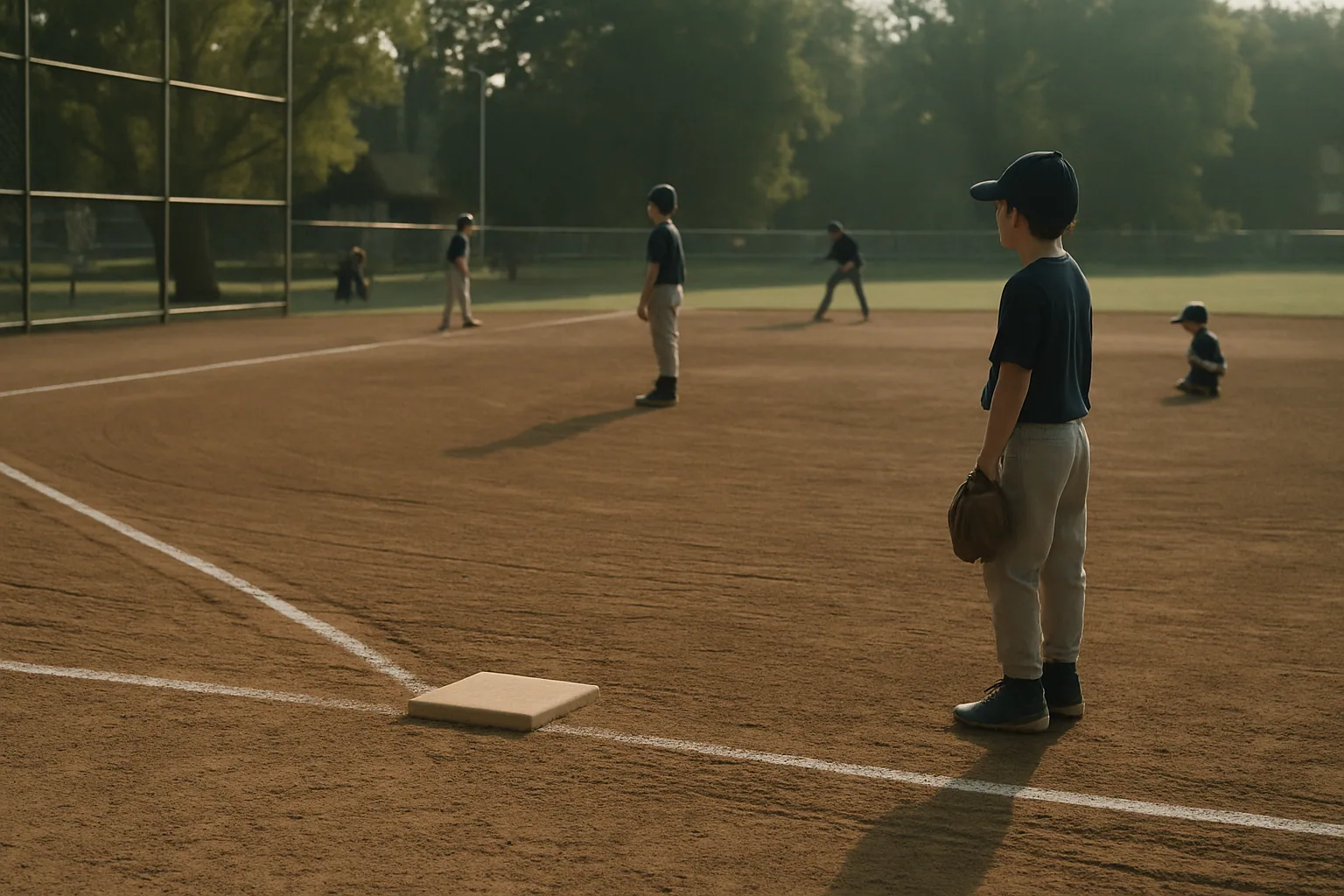
Run a station based practice lasting around 40 to 45 minutes that opens with a structured throwing warmup, rotates three stations approximately every 8 minutes, and closes with live at bats or a quick situational game. The three drills to lean on immediately are a close range throwing progression, coach knee or tee hitting, and an alligator hands fielding drill. At coach pitch ages, roughly 5 to 9, prioritize movement and confidence over mechanics. Run this plan, then adjust it week by week.
This post contains affiliate links. We make a small amount when you buy through them. We only recommend products we use ourselves.
TL;DR:
- Focusing on throwing progressions, fielding hand drills, and layered hitting practices ensures young players build confidence and skills without overwhelming them at this stage.
- Station-based drills should rotate every 8 minutes and include a mix of hitting, fielding, and throwing to maximize reps and minimize downtime for players.
- Safety protocols such as positioning the L-screen at 25-30 feet and wearing helmets during all swings are critical to prevent injuries during practice.
- A season plan should gradually introduce more complex situational plays from weeks 4 to 8, and full game-speed reps in weeks 9 to 12 to develop game readiness.
- Keeping instructions simple, limiting drill duration to 30 seconds, and rotating players consistently motivate kids and prevent burnout.
Table of Contents
- What Does a Coach Pitch Practice Plan Look Like?
- Core Throwing and Partner Catch Drills for Coach Pitch Players
- Hitting Drills: Coach on Knee and Tee Work
- Fielding Drills: Ground Balls, Alligator Hands, and Beginner Pickles
- Base Running and Situational Game Work
- The 12-Week Coach Pitch Progression
- Equipment, Setup, and Safety Checklist
- Short Cues and Parent Coach Scripts That Actually Work
- Coach’s Printable Setup Sheet
- A Parent Coach’s Honest Take on Coach Pitch Practice
- Plan Your Whole Season With Parent Coach Desk
- Sources
What Does a Coach Pitch Practice Plan Look Like?
A tight coach pitch practice plan runs 40 to 45 minutes and never lets a kid stand in a line for more than a couple of minutes. Coach pitch and machine pitch programs recommend building each session around five core activities: throwing, fielding, hitting, base running, and a competitive finish, all delivered through stations rather than one drill at a time for the whole team, according to the Coach-Pitch & Machine-Pitch Coaches Manual.
Here’s a run sheet you can use tonight:
- Throwing warmup (10 minutes). Partner catch starting at 15 feet, 10 clean throws focused on form, then step back to 30 feet for another set.
- Station rotation (24 minutes total, 8 minutes per station). Station A: hitting off a tee or coach pitching from a knee behind an L-screen. Station B: ground balls and alligator hands fielding. Station C: throwing relays and target accuracy games.
- Live finish (10 minutes). Either real at bats with a coach pitching, or a quick 21 game where hits and outs each count toward a target score.
Two volunteer helpers make this plan work: one running the hitting station behind the screen, one bouncing between fielding and throwing. If you’re short a helper, merge fielding and throwing into one longer station and add five minutes to the live finish. Keep the L-screen positioned about 25 to 30 feet in front of home plate, and consider pitching from a knee so hitters get a clean look at the ball at their eye level.
Core Throwing and Partner Catch Drills for Coach Pitch Players
Throwing is the skill that touches every other part of the game, and it’s the one most volunteer coaches under coach. A simple progression works better than a complicated one: start players close, build reps at that distance, then move them back in small steps. This mirrors the approach Veo recommends for protecting young arms while still building real mechanics.
- Start at 15 feet with a set of throws focused on a four seam grip and a step toward the target.
- Progress to about 25 feet for another throw set, ensuring proper elbow position.
- Finish at typical coach pitch game distance for a final set of throws.
- Teach two hand catches: thumb to thumb for anything above the waist, pinky to pinky for anything below, a cue straight from the coach pitch manual.
- Turn the last five minutes into a relay race between two lines, rewarding accuracy over speed.
Keep your corrections simple and concise, using brief cues like “Elbow,” “Step,” or “Target” to maintain the attention of young players.
Pro Tip: If a throwing drill keeps breaking down, don’t add more instruction. Shrink the distance instead. A kid who can’t hit a target at 25 feet often nails it at 15.
For more throwing progressions you can rotate in from week to week, A baseball throwing drills guide has additional variations built for this exact age group.
Hitting Drills: Coach on Knee and Tee Work
Hitting at coach pitch age is really about tracking the ball, not swing mechanics. The most reliable setup pairs a coach pitching from a knee behind an L-screen at 25 to 30 feet with regular tee work, so players see both a moving ball and a stationary one in the same session, a combination the Little League coach pitch program builds its hitting blocks around.
- Coach knee pitching, 25 to 30 feet, 8 to 10 pitches per hitter before rotating.
- Tee work for players waiting their turn, five swings each, focused on a level swing path.
- Soft toss from the side for hitters who are tracking well and ready for more movement.
- Mixing tee, soft toss, and live coach pitching in the same session lets players build mechanics without timing pressure, then add timing gradually, a sequencing approach supported by Little League’s own program guidance.
Quick stat check: the biggest lever for more contact isn’t a better swing cue, it’s more swings. A whiffle ball batting order game where every player bats twice before the inning ends will get more total swings into a 10 minute window than almost any structured drill.
Close the hitting block with a short team batting game, whiffle balls if space is tight, and rotate the batting order so nobody hits twice before everyone hits once.
Fielding Drills: Ground Balls, Alligator Hands, and Beginner Pickles
Good fielding at this age starts with hands, not feet. The alligator hands drill, glove down, mouth open, snap shut on the ball, teaches the two hand secure catch that turns routine grounders into outs instead of adventures. Pair it with short ground ball relays so every player is moving and fielding, not standing behind a line watching one kid field at a time.
Rundowns deserve a place in coach pitch practice too, just in a simplified form. A two line pickle drill with bases or cones set 20 to 30 feet apart, one runner between two fielders, works well as a starting point, and the BaseballMonkey pickle drill guide recommends keeping the target simple: get the tag in one or two throws. Don’t teach backup rotations yet. Two fielders and one runner is enough complexity for this age group.
| Fielding drill | Setup distance | Success metric |
|---|---|---|
| Alligator hands | 10 to 15 feet, coach rolls ball | Ball secured with two hands |
| Ground ball relay | Two lines, 15 to 20 feet apart | Clean transfer, accurate throw |
| Beginner two line pickle | 20 to 30 feet between bases | Tag applied in two throws or fewer |
Base Running and Situational Game Work
Base running eats up less practice time than throwing or hitting, but it’s where games get won or lost at this age. The single biggest habit to install is running through first base instead of slowing down to check where the ball went.
- Run through first (5 minutes). Line players up at home, have them sprint through the bag without decelerating, five reps each.
- Merry go round (5 minutes). Players jog the bases in sequence, practicing where to look for the next base and when to round versus stop.
- Advance decisions (5 minutes). Coach hits or throws a ball into the outfield, runner has to decide in real time whether to advance, a simple decision rep that pays off in games.
- Situational scrimmage close (10 minutes). A short 21 game or live at bats, coaching base running decisions in the moment rather than stopping play to lecture.
During the scrimmage, resist the urge to freeze the game every time something goes wrong. Let the play finish, then give one short correction before the next batter.
The 12-Week Coach Pitch Progression
A full season goes faster than it feels in week one, and having a rough map keeps you from cramming every skill into the last three practices. Little League’s 12 week coach pitch program breaks the season into three broad phases: early weeks build fundamentals, middle weeks add complexity, and late weeks shift toward game speed and situational reps, according to the Little League coach pitch program.
- Weeks 1 to 3: Grip, throwing to two hand targets, run through first base, and tee work to build a swing foundation.
- Weeks 4 to 8: Introduce simple situational plays, relay throws, beginner pickup rundowns, and fly ball tracking.
- Weeks 9 to 12: Game speed reps, outfield relays, live two line rundowns, and a final fun week built around scrimmages and season reflection.
| Phase | Weeks | Primary focus |
|---|---|---|
| Foundation | 1 to 3 | Grip, catch, run through first, tee swing |
| Build | 4 to 8 | Situational plays, relays, rundowns, fly balls |
| Game speed | 9 to 12 | Live reps, outfield throws, scrimmage, reflection |
Players who are ready to move beyond coach pitch mechanics sometimes get bumped into more advanced formats mid-season. If a few of your hitters are outgrowing coach pitch, A guide on the difference between coach pitch and kid pitch explains what changes and when that jump usually makes sense.
Equipment, Setup, and Safety Checklist
Safety at coach pitch age comes down to a handful of repeatable habits, not a long rulebook. The L-screen matters most: position it 25 to 30 feet in front of home plate, and pitch from a knee so hitters can track the ball at a consistent height, a setup Little League’s program specifically calls for.
- L-screen, positioned and checked before every hitting station.
- Helmets on for every swing, tee work included, no exceptions.
- Cones for stations and base markers.
- Extra bats and balls so a broken bat or lost ball doesn’t stall a station.
- A basic first aid kit within reach of whoever’s running the field.
| Item | Why it matters |
|---|---|
| L-screen | Protects the pitching coach at 25 to 30 feet |
| Helmets | Required for every hitter, every rep |
| Cones | Marks stations and base paths clearly |
| First aid kit | Handles scrapes and minor bumps fast |
A basic gear list for the season, including what’s worth buying versus skipping at this age, lives in a youth baseball gear guide.
Short Cues and Parent Coach Scripts That Actually Work
The best coaching at this age sounds almost too simple. Keep every instruction under 30 seconds, and when a drill isn’t working, make the task easier instead of explaining it longer, a principle that lines up with Little League’s own coaching guidance for this age range.
- Pre practice: “We’re throwing, hitting, and fielding today. Everybody gets a turn at everything.”
- Mid drill correction: “Glove down. Try again.” Not a paragraph, just two words.
- Post practice: “You all worked hard today. See you Thursday.”
Rotate positions and batting order every practice so playing time stays fair, and watch for the quiet kid who’s been standing at the back of every line. Burnout at this age usually looks like disengagement, not complaints.
Pro Tip: If you catch yourself talking for more than 30 seconds during a drill, stop. Say the one word cue and let them try again. Kids learn from reps, not lectures.
Coach’s Printable Setup Sheet
Screenshot this before your next practice:
- Warmup: 10 minutes, partner catch, 15 feet to 30 feet.
- Stations: 3 stations, 8 minutes each, hitting, fielding, throwing.
- Finish: 10 minutes, live at bats or a 21 game.
- Pack: L-screen, helmets, cones, extra balls, first aid kit.
- Short on helpers? Merge fielding and throwing into one station.
- Short on players? Run two stations instead of three and stretch each to 12 minutes.
| Time block | Focus |
|---|---|
| 0 to 10 min | Throwing warmup |
| 10 to 30 min | Three station rotation |
| 30 to 45 min | Live at bats or 21 game |
For a first-practice-specific version of this structure built for the very start of the season, see Parentcoachdesk’s First Practice Plan.
A Parent Coach’s Honest Take on Coach Pitch Practice
Perfect mechanics can wait. What can’t wait is whether a kid wants to come back next week, and that comes down to how much they moved and how often they succeeded at something small. The station model beats the single line drill every time, not because it’s more advanced, but because it multiplies reps and cuts standing time to almost nothing.
Run the 45 minute plan as written for the first few weeks. Once it feels automatic, start swapping in the progression for that stage of the season and adjust based on what your team actually needs, not what the calendar says they should know by now.
— Jeff
Plan Your Whole Season With Parent Coach Desk
Parentcoachdesk is the practical alternative to piecing together a season from scattered drill videos: one place with age specific practice structures, gear guidance, and the parent-coach scripts that keep a volunteer season running smoothly.
If you’re coaching kids in the 7 to 9 range, the Coaching 7–9 Year Olds guide walks through what to prioritize at this stage and why it’s often called the golden age for building real skill and love of the game. Download the companion First Practice Plan from that page before your next session, and you’ll walk in with a run sheet already built instead of scrambling the morning of. Coaches who also want a quick reference for filming practices to review swings or throws later can check the tips on filming youth sports without missing the live action.
Sources
- Little League — Coach-Pitch 12-Week Program (PDF)
- Coach-Pitch & Machine-Pitch Coaches Manual (Naperville Parks)
- BaseballMonkey — Pickle / Rundown Drill
- BattingLeadoff — How to execute a rundown (pickle) in baseball
- Veo — Coaching youth baseball: practice structure and age focus