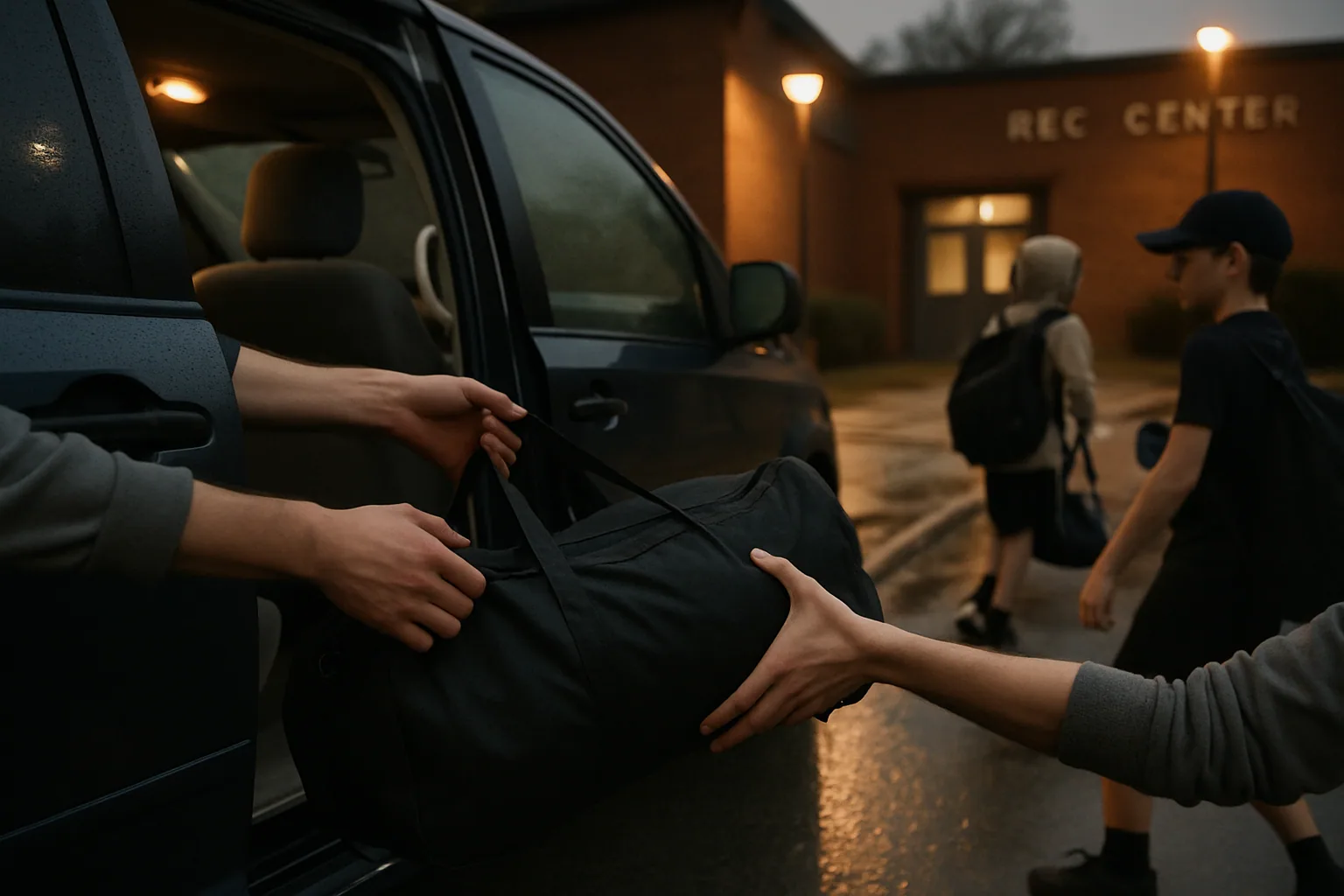
The car ride home after a game might matter more than the game itself. Not the drive to the field, not the warmup, not the post-game handshake line. The fifteen minutes between the parking lot and the driveway are when many kids decide how they feel about sports in general, and whether they want to keep playing.
Most parents do not know they are doing damage in those fifteen minutes. They think they are helping. They saw something in the second half, they have a question, they want to help their kid improve. So they ask. “Why didn’t you take more shots?” “What happened on that play in the third quarter?” “Did you even hear what the coach said about the spacing?”
Those are not cruel things to say. But they land in the car before the kid has even taken off their cleats, while the game is still in the body, before processing has happened. The result is that the kid climbs out of the car feeling evaluated instead of supported.
Here is what kids actually need after competition: food, water, and the clear signal that their value did not change based on what happened on the field. That is the whole list. Everything else can wait.
The two questions that almost always work are the simplest ones. “Did you have fun?” and “What was your favorite part?” Both invite conversation without evaluation. They let the kid pick what to share. They signal that the parent’s interest is in the kid’s experience, not in the parent’s analysis of the performance. Most of the time, kids will talk when they feel safe and stay quiet when they feel interrogated.
Sometimes silence is the right answer and the right move is to let the kid decide whether they want to talk. Drive. Let music play. Stop for food. Give it space. A lot of parents interpret silence as a problem and try to fill it. Often the silence is just the kid coming down from the adrenaline. Filling it with questions or commentary interrupts a process that does not need interrupting.
The single most useful thing a parent can say after any game, good or bad, is this: “I love watching you play.” That is it. No conditions. No performance qualifier. Not “I loved how you played today” or “I love when you play like that.” Just the unconditional version.
It tells the kid that showing up and competing is enough to be worth watching. It anchors the parent’s presence at games in love and interest rather than evaluation. It is free to say and it costs nothing and most kids do not hear it enough.
After a tough game, the kid already knows they struggled. Parents often feel the need to identify the problem, as if the kid missed it and needs help locating the issue. They did not miss it. They lived it. The more useful thing is a brief acknowledgment that hard days exist and are normal, followed by the signal that tomorrow is a new day. “You had a tough one. That happens to everyone. You’ll get back at it.”
After a great game, the upgrade on empty praise is to celebrate behaviors instead of outcomes. “Three goals” is a fact about the scoreboard. “You competed through every shift and never stopped moving” is information about who the kid is as a competitor. The second one sticks longer because it describes something the kid can replicate.
It is also less fragile. When the three-goal game does not repeat next week, the parent who praised the output has an implicit comparison available. The parent who praised the effort has a consistent standard.
The long game here is the one that matters most. Kids who experience the car ride as safe and unconditional are more likely to stay in sports through the hard stretches, more likely to take competitive risks because failure is not followed by a debrief, and more likely to build the kind of confidence that holds up when the results do not.
The car ride is not a minor variable. It is the frame around everything else the sport is trying to