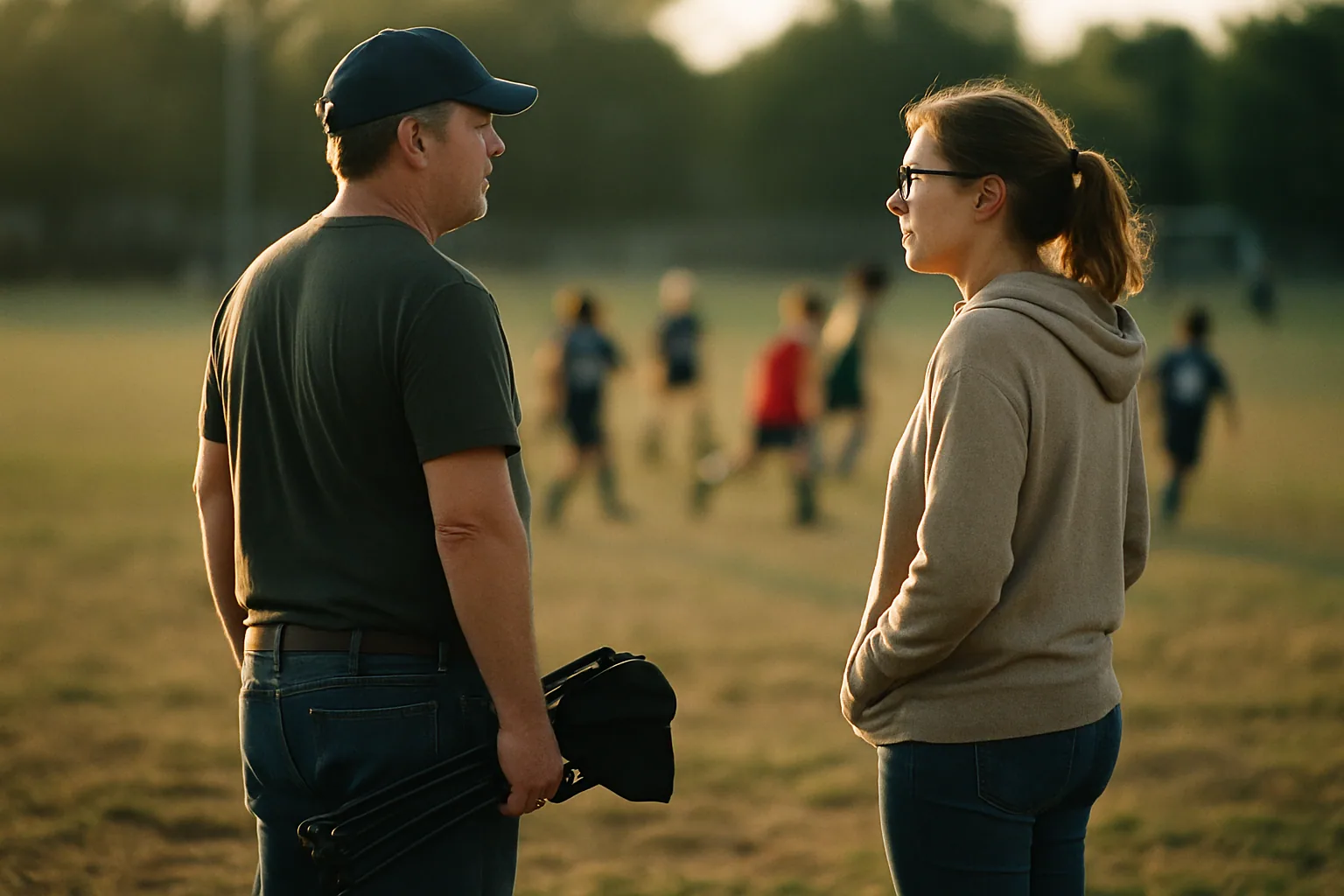
At some point during the season, every player on your team should have a conversation with you that is not about their playing time, not about their technique, and not about what the team needs from them this weekend. A conversation that is just, how are you doing. What’s going on. Is there anything I should know.
Most coaches don’t do this. Not because they don’t care. Because there’s always something more urgent: the upcoming game, the parent who emailed, the kid whose positioning has been off for three practices. The one-on-one check-in gets pushed to later and later until the season is over and it never happened.
That’s a real loss. Not because you’re going to uncover some crisis in every conversation, most of them won’t have one. But because the kid who sits down with their coach for ten minutes and gets asked how they’re actually doing walks away knowing something: someone in charge is paying attention to me specifically. That knowing changes how they show up for the rest of the season.
The conversation is not complicated. You don’t need training to do it. You need five to ten minutes and a genuine interest in the answer.
The opening question matters. “How’s your season going?” gets you a performance answer, they’ll tell you about their stats, their playing time, the game they thought went well. That’s not what you’re after. The questions that get to something real are slightly off the performance axis: “How are you doing outside of this?” “What’s life been like lately?” “Anything on your mind this week that isn’t practice?” Those sound simple. They are. And most kids, when asked by an adult they respect, will actually answer.
Some kids will give you a one-word answer at first. Fine. Stay with it. “Yeah? What else?” You don’t have to probe hard. You just have to signal that you have time and you’re not in a hurry. Kids answer longer questions when they can tell the adult actually wants to hear what they’re going to say.
The listening part is where most coaches struggle, because listening without solving is uncomfortable. A kid mentions something going on at home and the instinct is to respond with advice or reassurance or a redirect to “the mental side of the game.” All of those shut the conversation down. The kid made a small offer. They were seeing if you’d accept it. If you immediately convert it into a coaching moment, they learned that this conversation is still fundamentally about performance.
The move is to stay with what they said. “Tell me more about that.” “How long has that been going on?” “That sounds like a lot.” You are not fixing anything. You’re acknowledging that what they said is real and worth hearing. That alone is more than most kids get from most adults in their lives.
There will be things that come out of these conversations that require follow-up. A kid mentions something at home that sounds like more than ordinary stress. A kid says they’ve been feeling anxious about the sport in a way that isn’t going away. A kid brings up something about a teammate that you need to know. None of those are problems with the conversation. Those are the conversation working. You handle the information appropriately, and “appropriately” sometimes means connecting a kid with a school counselor, a parent, or someone else who can actually help, but you don’t regret the fact that you now know.
Logistically, coaches always ask when and how to make these happen. The answer depends on your team’s schedule and your own time, but the mechanics are simpler than they sound.
The most available window is usually the before and after: the five minutes before the start of practice when kids are arriving and putting their stuff down, and the five minutes after when they’re packing up to leave. You’re already there. The team isn’t all together yet or has just dispersed. You pull one kid aside, “Hey, can I grab you for a second?”, and you do it there.
Some coaches build in a rotation: one player per week, you pull them aside or walk with them between drills, and by mid-season you’ve had the conversation with everyone. On a team of twelve, that’s less than a season’s worth of weeks. You can do this without disrupting any practice or scheduling any special time.
The only requirement is that you actually do it, which means you actually track who you’ve talked to. A simple list with checkmarks. Twelve names. Check them off as the season goes. Don’t let the urgent always push out the important.
What you do with what you learn is mostly up to your judgment, but a few things are worth saying directly.
Write down what you learned. Not in an elaborate file, just a quick note on your phone after the conversation. A year later you will not remember that Jordan mentioned his parents were going through something difficult, or that Aisha said she’d been struggling with sleep. But at the end of the season when you’re writing recognition for each player, or midseason when you notice a kid seeming off, you’ll want that information. A 10-word note per player is enough.
Don’t use what you learn as material for practice or games. If a kid tells you something private and then you reference it in front of the team, you’ve broken the agreement the conversation created. What happens in the one-on-one stays there unless the kid brings it into a group context themselves.
If something comes out that requires a mandatory reporter conversation, anything involving a kid’s safety, you know what to do. That threshold doesn’t come up often. When it does, you act.
The other thing worth naming is what these conversations do for you. Coaching is easier when you know who your players actually are. The kid who’s been distracted at practice, turns out her grandmother is in the hospital. The kid who seemed like he was slacking, turns out he’s been doing two-hour commutes three days a week because his family moved. The kid who you thought just didn’t care, turns out she’s been dealing with something at school that she hasn’t told anyone. None of that is information you could have gotten from watching practice. You had to ask.
The coach who knows this stuff coaches differently. Not softer, differently. They give the distracted kid a different kind of attention. They frame the commuting kid’s contribution in a way that acknowledges what he’s managing. They check in with the struggling kid more often. That’s not charity. That’s precision. You’re responding to the actual situation rather than what it looks like from the outside.
Youth sports is full of coaches who are good at the technical work, who can correct a footwork error, design a solid practice plan, manage a rotation. Fewer coaches are good at the individual relationship, because the individual relationship requires time and vulnerability and a willingness to hear things that aren’t about the sport.
That’s exactly what makes it high-leverage. Most of your players’ coaches won’t have this conversation with them. You will. That’s what they’ll remember, not the drill you ran in week four, not the play that worked in the semifinal. The coach who pulled them aside one afternoon and asked how they were actually doing, and then sat there and listened to the answer.
That’s the most important conversation you’ll have with every player. Make time for it.