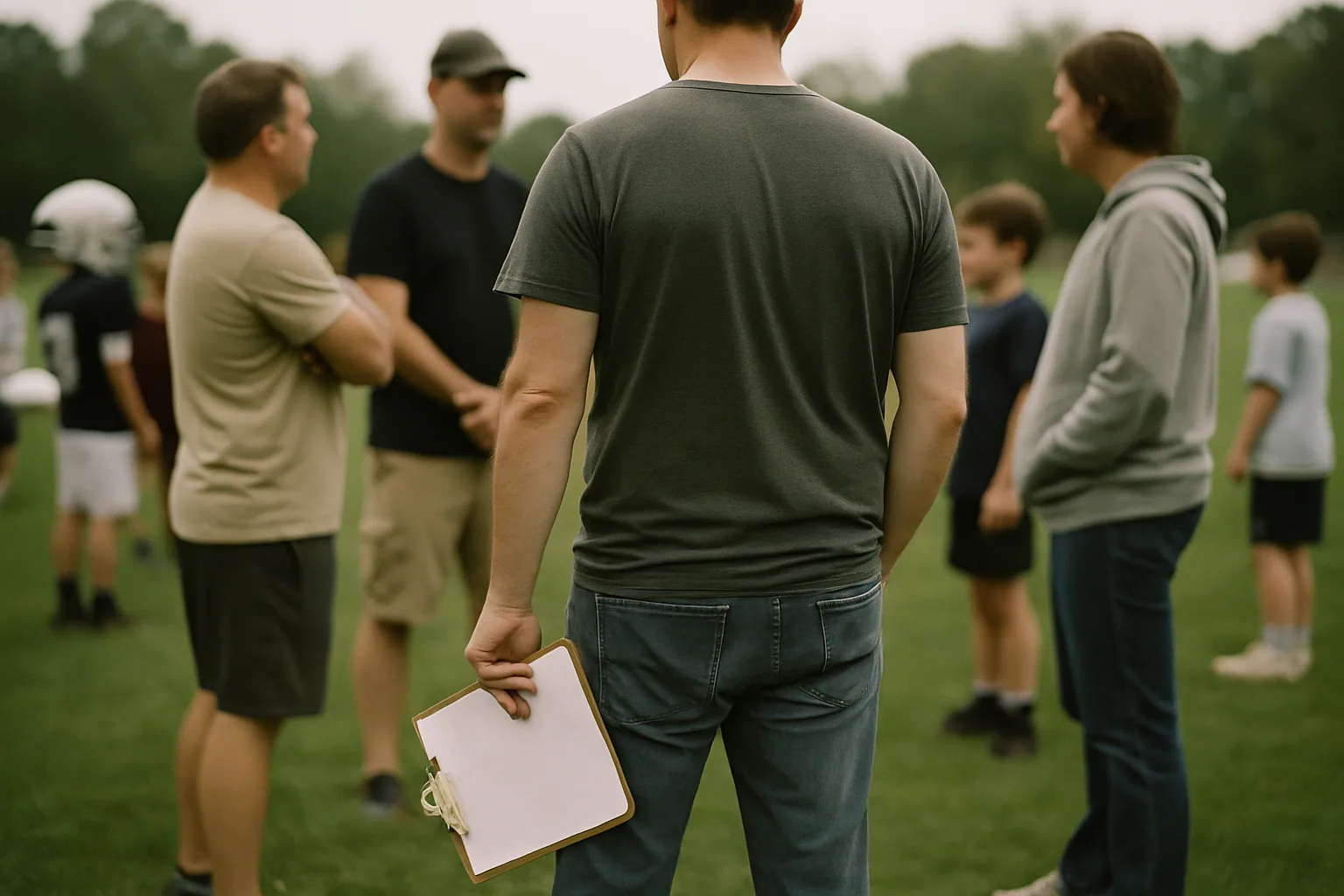
Put twelve kids together and within two weeks they’ll have sorted themselves. The three who’ve been on the same team for three years will sit together. The two who go to the same school will pair up automatically. The kid who just moved to the district will find the edge of whatever cluster will have them. This happens without anyone deciding to do it. Social gravity is just that reliable.
That’s not a clique. That’s a team. Clusters are normal.
A clique is something different. A clique is a cluster that has organized itself around exclusion, one that has decided who is in and who is out, and that enforces the boundary actively. The look when the outside kid tries to get in the group photo. The group chat that half the team knows about and the other half doesn’t. The seating arrangement at team meals that stays exactly the same every time, and everyone knows why.
The coach’s job is not to eliminate social structure. You can’t do that and you shouldn’t try. The job is to notice when clusters become cliques and move before it calcifies into the team’s identity.
Spotting it is the first step, and it’s easier than most coaches acknowledge. You’re at practice every day. You see who warms up with whom, who pairs up in drills when you say “find a partner,” who is on the fringes during water breaks. The patterns are visible if you’re looking for them.
The specific tells: one cluster that always eats together and no one from outside the cluster has joined them in three weeks. A kid who never has a partner when you call for partners and always ends up with you assigning them one. Inside jokes and references in team settings that a subset of the team clearly doesn’t share. Small-group competitions where the same kids pick each other first every time, and the same kids end up last every time.
None of those alone are a crisis. The pattern over time is what tells you something is wrong. When you see the same three kids excluded from the same social configurations repeatedly across multiple contexts, that’s the signal.
The instinct when you notice clique behavior is to address it as a culture problem, to stop practice, bring the team in, and give a speech about inclusion and team unity. That instinct is wrong, or at least incomplete.
Speeches don’t break up cliques. The kids in the clique hear the speech and nod and nothing changes, because the behavior that creates exclusion is social, not moral. They’re not failing to include others because they haven’t been told inclusion is good. They’re excluding others because their social cluster has established its membership, and a five-minute speech doesn’t restructure a social group.
What restructures social groups is repeated interaction in different configurations. That’s the actual tool.
The practice move that works is deliberate reorganization of who works with whom. Not once. Every single time you call for partners or small groups, you assign them. Randomly, on purpose. “Connor, you’re with Maya. Jordan, you’re with Sasha. Malik, you’re with Tyler.” Pull names. Rotate groupings mid-drill. Set up skill competitions where the teams are scrambled differently for each round.
The first time you do this, the clique kids will find each other at water breaks. Fine. The second time, they’ll pair up in the next drill. You reassign. The third time, they’ve been working with enough different people that the habit starts to form, that practice is a place where you work with everyone, not just your cluster. The social bonding is starting to spread.
This requires consistency from the coach. You have to be willing to assign groups every single time, even when it’s faster to just say “find a partner.” The efficiency cost is small. The culture payoff is real.
There’s a version of clique behavior that involves exclusion plus active unkindness, the eye rolls, the comments under the breath, the coordinated freeze-out of one specific teammate. That version needs a different response, and it needs a private one.
The coach who catches this talking to the specific kids involved, not the team, is on the right track. “I’ve noticed some things in practice that I want to address directly with you. What’s going on between you and Tyler?” That’s the opening. Then you listen. What comes out of that conversation will tell you whether this is garden-variety social sorting or something more serious.
The thing to avoid in that conversation is a lecture about how exclusion is wrong. You’ll get compliance and eye contact and nothing will change. What works is specific expectation-setting: “I need you to be a teammate to everyone on this team during practice. That means in drills, during breaks, during travel. I’ll be watching, and I’ll address it directly if I see it again.” Then you actually watch, and you actually address it.
Parent-driven cliques are the harder version of this problem. Sometimes the cluster of kids who always pair up at practice is the same cluster whose parents always sit together at games, whose families socialize together, who chose this program because their kids could be on the same team. The clique is coming from the adult social layer, not the kid layer.
When that’s the case, restructuring partner drills helps, but it’s slower to take effect because the kids are reinforcing the structure outside of your environment. Your best tool is still consistent mixing at practice and attention to the kids on the outside of those clusters. Make sure the kid who’s not in the family social group still has a specific partner, still gets called out by name in positive contexts, still feels present on the team you’re running.
You can’t fix the parent social dynamic. You can make sure it doesn’t define what the team feels like from the inside.
The time to address clique formation is early in the season, not late. By mid-season the patterns are established and harder to shift. In the first three weeks, the social architecture is still being built. That’s when deliberately assigned partner drills and rotated small groups do the most work, because they’re shaping habits before habits have formed.
Some coaches build in a rule from day one: “On this team, I assign partners. Always.” The team never develops the expectation that they choose their own partners, so there’s nothing to fight when you mix things up. The culture starts with the structure, before anyone has organized themselves into anything.
The goal at the end of this is not that every kid is best friends. That’s not what teams are for. The goal is that every kid on your roster can work productively with every other kid on the roster. That they don’t avoid each other, don’t exclude each other in team settings, and don’t create a social structure so rigid that it becomes something kids on the outside of it dread coming to practice. That’s achievable. It requires deliberate structure and consistent attention, and it doesn’t cost anything except the habit of mixing up your groups.