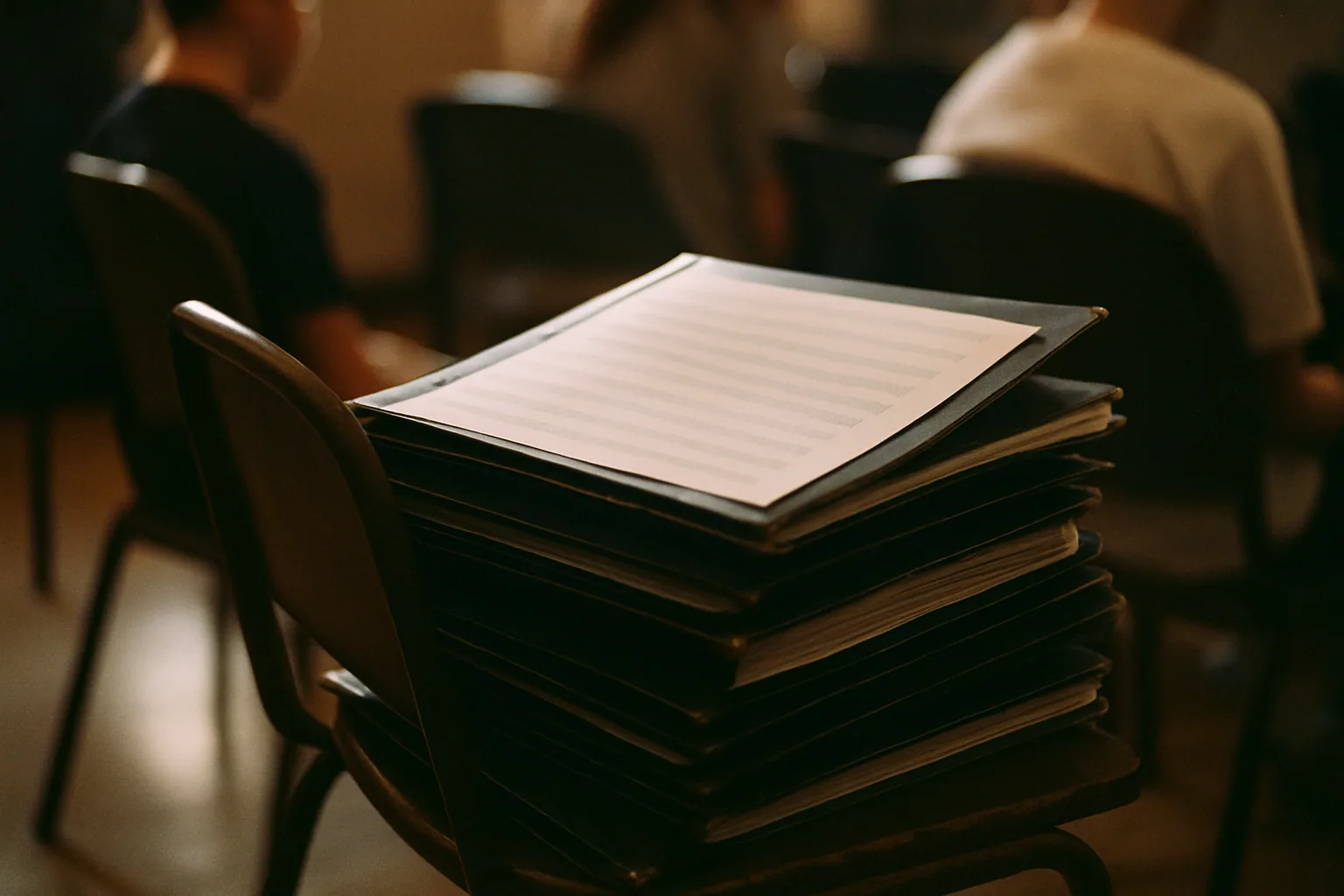
She decided over breakfast on a Tuesday in September that she’s going to try for all-state choir this year. The audition is in January, she’s in ninth grade, and the kids who usually make it are juniors and seniors. You said good for you and poured more coffee. Then she left for school and you sat there for a minute and Googled it. Here’s what an all-state audition actually involves, and the part that matters most.
What the audition usually involves
Most all-state choir auditions have four parts, though they vary by state. A prepared piece, often a movement of a classical work, sung from memory, anywhere from thirty-two bars to two minutes long. Sight-reading: the panel hands her a short piece she’s never seen, she gets a minute to look at it, then she sings it. A vocalize or scale: the panel asks for major scales, arpeggios, or vocal exercises that test range and intonation. And a short interview or musical question, sometimes the panel asks about key signatures, intervals, or musical terms.
The sight-reading is the most heavily weighted part in most state systems, and that’s where the audition is actually won or lost.
Why sight-reading matters so much
An all-state choir comes together for a single weekend, they rehearse for two days under a guest conductor, perform a concert, and go home. The repertoire is hard, there’s no time to teach the music by rote, and every kid has to walk in with sight-reading skills strong enough to learn her part in two rehearsals. The audition is, in part, testing whether she can keep up at that pace.
How to build sight-reading
Sight-reading is a skill, not a talent. It’s built by doing. Six months before audition season, she should be doing five to ten minutes of sight-reading every single day, not most days, every day. There are excellent sight-reading apps and websites that drill this, and most teachers will recommend one. She sees a piece of music for the first time, sings it, then sees the answer, marks what she got wrong, and does it again the next day.
The choir teacher can give a placement test of sorts, a piece she’s never seen at the difficulty level of the audition. If she can sing it accurately on first sight, she’s ready. If she’s flailing, she needs months of practice.
The prepared piece
The audition packet is usually released two to three months before audition day. She gets the music and starts working. A good private teacher is invaluable here, the piece has to be memorized, in tune, with correct dynamics and phrasing, and most kids can’t do that themselves at thirteen or fourteen.
If she’s auditioning without a private teacher, the choir director sometimes offers prep sessions. Take advantage. Even a few sessions can make a difference.
What the panel listens for
The audition is usually behind a screen. The panel can’t see her. They only hear her, and they listen for three things above all. Pitch accuracy, can she sing the right notes at the right time without sliding up or down to them. Tone quality, is the voice clear, supported, free of strain, because beauty matters but a clean tone matters more than a beautiful one. A panel forgives a small voice, but they don’t forgive a strained one. And musicianship, does she phrase the music, observe dynamics, show that she understands what the piece is about, not just how to make the notes.
A flashy high note that’s out of tune doesn’t help. A quiet, clean phrase that lands in the right key does.
The audition day
Warm up at home, not just at the venue, the voice needs about twenty minutes of singing to settle. Hydrate two days before, with water and sleep. No dairy the morning of, no spicy food the night before. Eat something light an hour before, a banana, a piece of toast, not eggs, not coffee, coffee dries the voice. Bring two copies of the prepared music in a black folder. Wear clothes she feels good in, not concert dress, just clean clothes she can sing in. Get there thirty minutes early; she needs bathroom, warm-up, breathing.
After the audition
Results are usually posted later that day or by email within a week. If she makes it, the choir weekend is a real experience, the repertoire is hard, the conductor is a professional, the kid will sing pieces at a level she’s never sung before, and she’ll meet two hundred other kids who care about singing. Making all-state is also a meaningful line on a college music application.
If she doesn’t make it, here’s the truth: most kids who eventually make all-state didn’t make it on their first try. The audition is a snapshot, and the work continues. Ask her home teacher to look at the video and the application. Sometimes there’s a fixable issue. Sometimes the kid just isn’t ready this year.
A small piece of advice
If your kid is intimidated by the audition, don’t minimize it. Tell her this is a real test. Some of the kids in the room have been preparing for this since sixth grade. The audition is hard. Then help her practice the sight-reading every day. The kid who does five minutes a day for six months walks into the room ready. The kid who crammed two weeks before walks in nervous.
This is one of the few skills where consistency beats intensity. Five minutes a day, every day, through the holidays, through illness, through any other practice slowdown. The kids who make all-state are the kids who did the boring daily thing. The pathway by age covers how the all-state track builds from middle school on, if this is the first of several tries.